

Kerala’s Industrial Future
P.K. Kunhalikutty
Minister for Industries & Commerce, Information Technology, Artificial Intelligence, Startups, Mining and Geology, Handlooms & Textiles
 A comprehensive vision for transforming Kerala into an investment-friendly, innovation-driven, and sustainable industrial hub while creating meaningful opportunities for its youth
For decades, discussions surrounding Kerala’s development have largely revolved around its remarkable achievements in education, healthcare, and social progress. These accomplishments have placed the state among the most socially advanced regions in India. However, Kerala possesses far greater potential beyond these conventional strengths. With its rich reserves of knowledge, skilled human resources, and intellectual capital, Kerala has the capability to emerge as one of India’s most modern, sustainable, and globally competitive industrial destinations.
A comprehensive vision for transforming Kerala into an investment-friendly, innovation-driven, and sustainable industrial hub while creating meaningful opportunities for its youth
At a time when the global economy is changing faster than anticipated—driven by technological innovation, digital transformation, and international capital flows—it is imperative for Kerala to redefine its economic future. Growth today is increasingly shaped by artificial intelligence, automation, innovation ecosystems, and future-ready industries. Kerala must adapt to this rapidly evolving industrial landscape to secure its place in the new global order.
The most pressing challenge before Kerala today is not merely economic growth, but the creation of meaningful employment opportunities for its youth. The state is home to one of India’s most educated and diverse young populations. Yet, despite their qualifications and capabilities, many continue to seek employment outside Kerala and even abroad. This migration of talent is a challenge that demands urgent intervention.
The government’s vision is to transform Kerala into a state where young people can find opportunities that align with their skills and aspirations. Kerala has several untapped advantages that can be strategically leveraged for this purpose. These include world-class human development indicators, anexcellent quality of life, favourable climatic conditions, robust digital connectivity, and an extensive global diaspora network. These strengths must now be converted into engines of economic growth.
Kerala’s industrial journey has its own unique historical foundation. The state’s industrial sector was built upon public sector enterprises, micro, small and medium industries, and traditional sectors such as handloom, khadi, coir, and cashew. Cooperative movements have also played a major role in shaping the industrial base. These sectors were given priority in earlier phases of development and continue to remain relevant. However, the changing realities of global competition, technological advancements, and evolving investment patterns present new challenges that cannot be ignored.
The government’s vision is to transform Kerala into a state where young people can find opportunities that align with their skills and aspirations.
To achieve industrial growth in the present era, it is essential to create a truly investor-friendly ecosystem. Administrative approvals must be provided within fixed timelines, procedures should be simplified, unnecessary delays must be eliminated, and services should be delivered efficiently. These are not optional reforms but essential foundations for industrial expansion.
While large-scale investments often dominate public attention, micro, small, and medium enterprises (MSMEs) remain the backbone of Kerala’s industrial economy. Their contribution to employment generation and local economic activity is immense. Strengthening this sector through targeted interventions can create substantial employment opportunities with relatively lower investment.
For MSMEs to succeed in a competitive market, improvements in product quality, technological adoption, and marketing capabilities are essential. Recognising this, the government has formulated the Kerala MSME Growth Scheme, a comprehensive initiative aimed at launching ten thousand micro and small enterprises. This programme seeks to empower entrepreneurs by helping them access global markets through digital technologies, e-commerce platforms, artificial intelligence, and automation.
 The government will provide support, incentives, and tax benefits for enterprises based on advanced technologies. In addition, entrepreneurs facing financial challenges will have access to revolving funds, technology funds, and challenge funds. Expert assistance in technology and management will also be made available to ensure sustainability and efficiency. An allocation of ₹100 crore has been earmarked for this initiative.
To further encourage entrepreneurship among young people, the government will provide interest-free loans up to ₹5 lakh under the Indira Guarantee scheme.
To further encourage entrepreneurship among young people, the government will provide interest-free loans up to ₹5 lakh under the Indira Guarantee scheme. This initiative is expected to attract and motivate many aspiring entrepreneurs to start their own ventures.
Kerala’s unique and traditional products deserve stronger recognition and wider market access, both nationally and internationally. For this purpose, the government will launch the “Brand Kerala” initiative. This programme will aim to establish Kerala’s indigenous products as trusted and premium brands in global markets.
Traditional sectors such as handloom, handicrafts, cashew, and coir will receive additional support and new development programmes to strengthen their relevance in the modern economy. At the same time, incubation centres will be established to help next-generation entrepreneurs transform innovative ideas into viable business enterprises.
To attract investments in sectors such as manufacturing, logistics, technology, and renewable energy, the government plans to establish Special Investment Zones. These zones will be designed to enhance Kerala’s competitiveness with other leading investment destinations in India. Through agencies such as KINFRA and INKEL, new industrial areas will also be developed near ports and airports, thereby improving logistical efficiency and industrial accessibility.
Recognising the importance of supply chain infrastructure, the government will formulate policy guidelines to strengthen logistics infrastructure across the state. Furthermore, to attract investments
from Non-Resident Keralites engaged in business abroad, the NORKA Private Industrial Estate Scheme will be introduced.
The government has formulated the Kerala MSME Growth Scheme, a comprehensive initiative aimed at launching ten thousand micro and small enterprises.
Despite its strengths, Kerala faces structural challenges that often discourage investors. Compared to other states, limited land availability, high land costs, higher wage structures, and procedural delays have contributed to the perception that Kerala is not fully investment friendly.
To overcome these barriers, the government will establish a datadriven Invest Kerala special cell. This mechanism will function as a single-window system to facilitate land acquisition, expedite legal
clearances, and provide postinvestment support at every stage. By reducing uncertainty and improving transparency, this cell aims to build greater investor confidence.
In addition, an Investment Advisory Council will be formed under the chairmanship of the Chief Minister, with the Minister for Industries and IT serving as Vice-Chairman. The council will include domain experts from relevant sectors and will provide guidance for monitoring and expediting projects on a priority basis. This marks an important step towards bringing greater professionalism and strategic oversight into the state’s investment promotion mechanisms.
 The government also plans to establish a Global Watch Tower to monitor employment trends both within India and internationally. This institution will identify emerging skill demands, recommend curriculum reforms, and strengthen industryacademia partnerships. Budgetary allocations have already been made for this initiative, reflecting the government’s commitment to preparing Kerala’s workforce forfuture economic realities.
At the same time, the government remains committed to preserving the social responsibility and developmental role of the public sector while simultaneously encouraging private investment and global capital participation. The approach is not one of replacement, but balance and partnership.
Kerala’s next phase of development will be built upon focused policy-making, swift project execution, large-scale investments, and a strong startup ecosystem. Beyond the traditional IT sector, the government is now targeting future technologies as the foundation of the state’s next growth cycle.
Sectors such as artificial intelligence, biotechnology, semiconductors, robotics, quantum computing, and digital public infrastructure are redefining the global economy. Kerala intends to position itself as a major centre for these emerging industries. To achieve this, the government plans strategic partnerships with global technology companies and innovation ecosystems to attract technology
investments, global capability centres, startups, and future industries into the state.
A “Future Corporation” will also be established with the objective of promoting technology investments, providing startup funding, and creating employment opportunities in next-generation industries.
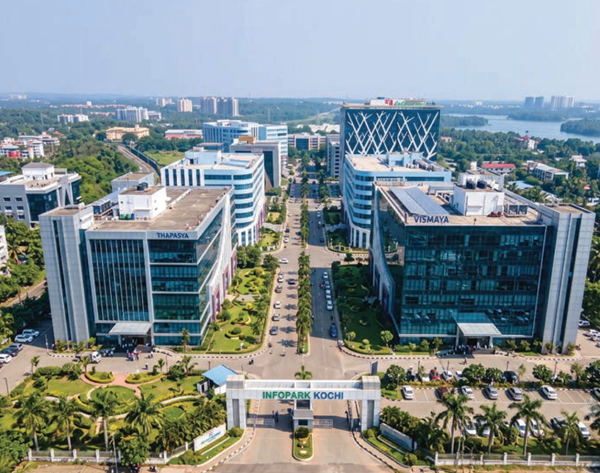
Kerala’s IT parks will be transformed into hubs for future technologies. While Technopark in Thiruvananthapuram and Infopark in Kochi continue to lead the state’s digital economy, the government now aims to develop Cyberpark in Kozhikode as Kerala’s next major IT destination.
In addition, a Private Technology Park Promotion Scheme will be launched to encourage the establishment of privately managed technology parks, thereby expanding Kerala’s innovation ecosystem.
Finally, Kerala’s youth must be prepared not only for the jobs of today, but for the industries of tomorrow. To bridge the gap between corporate requirements and youth capabilities, the government will introduce a comprehensive Talent Dashboard. This system will help map industry needs with available skills, creating a more efficient employment ecosystem.
Technical college syllabi will be continuously updated in collaboration with industry leaders to ensure students remain aligned with changing global technological trends. Special emphasis will be placed on emerging fields such as artificial intelligence, semiconductors, cybersecurity, robotics, and data science.
In partnership with leading institutions both within India and abroad, the government will also organise specialised skill development programmes and reskilling courses. These initiatives
will ensure that Kerala’s youth remain competitive, adaptable, and prepared to lead in the industries of the future.
The vision for Kerala is clear: a state that remains socially progressive while becoming economically dynamic; a state that balances tradition with innovation; and a state that offers its young people not only hope, but opportunity.
Through strategic investments, policy reforms, and a future-oriented industrial ecosystem, Kerala stands poised to redefine itself as an investment-friendly and sustainable economic powerhouse.