

KERALA’S TRIBAL STORY THAT TRAVELS TIME
Unnikrishnan Avla is a school teacher turned film maker whose film Life of a Phallusreceived three awards at IFFK 2025- jury award, NETPAK, and the audience choice.The film tells the story of Cholanaikkar tribal community, Asia’s only cave dwellers; filmed in their own language and cast from the same community, first of this kind.The author shares his experience with six years participatory observation and research about Cholanaikkars and how this piece of art travels abroad and time.
-Unnikrishnan Avla
Art travels to its audience! Whether it is a theatrical production, paintings, cinema, music or dance performances. At times it carries the tragedy of the pastand inflicts pain to the present.The film, Life of Phallus portrays the life, language, and political experiences of the isolated Cholanaikkar tribal community of Kerala. One has to have strong visual language and do not compromise on visual abundance to navigate the miserable story of the sons of the forests whose innocence was deceived by a group of native people and policies. The film features the identity crisis of youngsters among Cholanaikkar, the resultant of forceful sterilisation during emergency which ended up in shortage of members and partner hunting within the community.
 Researches and Observations for the Film
The Cholanaikkans are isolated hunter-gatherer tribe in Kerala’s Nilambur forests, living in rock shelters (caves) and known as Kerala’s Cavemen.Cholanaikkarsare of the habit of food gathering; collectively go to deep forest to collect roots, tubers, fruits and honey. They predominantly depended on the system of exchange of goods (barter system). They practice a unique Dravidian language, and guided by nature’s rhythms rather than modern timekeeping; and the film was shot in the real eco system to capture this. The film used humming of singer Janaki Easwar to createambience of deep forest. The tribe has many unique practices and beliefs which they keep sacred. Children of Cholanaikkartribe,mostly rear by grandparents, are not emotionally connected with their biological parents as they leave them behind when they go to deep forest for food gathering.
Impact of Emergency
The Cholanaikkarsare only 198 members now, which is probably, the resultant offorceful sterilisation many of them had undergone during emergency. They are one of the three tribal communities of Kerala who were forcefully vasectomised during emergency. Now, this primitive community faces scarcity of females. The present-day members of the tribe are the living memory of this 75 years old bizarre truth. All other incidents in the movie faced by the younger generation such as identity crisis, mate hunting and exploitations by local natives are connected with this incident.
Casting
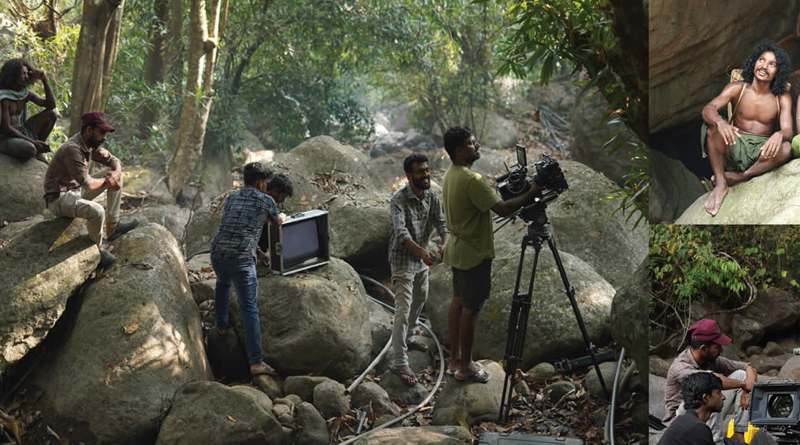
Except one or two, most of the actors are from the Cholanaikkarscommunity. The task was that they were not trained actors and were not exposed to the reel world; it was not an easy task to make them learn the scripted dialogue. It has to come from within. Moreover, they are very independent people from their childhood; it is tough for them to behave in a controlled situation. I made them grow to the situation and shot their own dialogues contextually. They carried the heaviness of life experience brilliantly in the film. Eventually they became the characters;the line betweenthe person and character withered. That is the reason film feels less staged and more observed. The film was not dubbed. We had to face the difficulties of real time capturing. Jibs were not used to shoot heights and no AI images were created. It took six years to complete the process.
Unnatural Circumstance for Natural Scenes
The actors have to explain many a times about the shooting, which is an artificial circumstance. We have to shoot them very naturally. Whenever they had shooting outside the forest, they had to compromise a lot to stay in a resort or adapted to modern situations. Most of them were not in the habit of moving out of their habitat for a long time. But they sacrificed many of there comforts and reached Thiruvananthapuram when we had the world premier at IFFK.
With the opening scene, set in an operation theatre, a historical wound was created which directly moved to the next generation. The pain of this historical wound imposed upon marginasied is effectively carried away by the humming voice of Singer Janaki Easwar and background score on duduk, played by Russian musician Dimitry. The shots of forest as an unromantic place of everyday labour, naturality of collective life, laughter, small conflicts and deep silence of forest were key elements of the film.
Kerala’s art has the legacy of travelling. Kathakali and Mohiniyattam travelled all over the world with Malayali Diaspora and otherwise. Indian Cinema, especially Malayalam and Bengali films travelled globally as an art representing India. Life of Phallus too sets its travel beyond the borders to unveil how India’s Emergency impacted the most marginalised and isolated communities.