

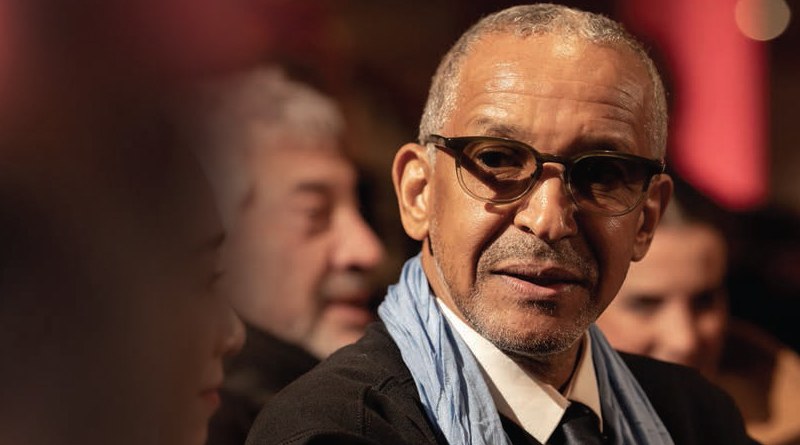
Migration is Hope in My Cinema
INTERVIEW / ABDERRAHMANE SISSAKO
 Art and cultural festivals are platforms for underrepresented voicesand especially film festivals explore identity and postcolonial revisits. Where do you place Kerala’s environment as an international festival destination?
My first visit to India was 25 years ago and was associated with Malayalam cinema. I was invited as a guest of IFFK held in Calicut. My second visit to Kerala is to be part of the 30th IFFK. Even after 25 years I really see the same passionate and curious audience. The generation might have changed but this society respects cinema and carries the same passion and curiosity. Beauty of this land and yummy cuisines are not changed. Thiruvananthapuram is a quiet City, so as people in Kerala are. This is the similarity I found with Africans and Keralites. Despite the geographical differences, there are cultural similarities between India and Africa. Both the countries were colonised and people fought for independence. Our power is not in globalisation. The concept of culture of these countries is different from globalisation.
Many of your films portray globally relevant social issues taking place in a particular locality of Africa and its cultural background but it has relevance in the third world countries and this makes your films that of international relevance. What is your philosophy of making a film of this sort?
I portray my vision of art and cinema, which engage indigenous people and community in conflict with foreign elements, which is everywhere. However, I do not follow strong and complicated philosophies while making a movie. My films are not really meant to be so. But what is clear to me is the end of western concept of life and development. They donot see the end of something and ignore such societies or places like my continent Africa and Asia where indigenous and ethnic ethos are stronger and continue to be stronger. Life is still hard for some people and societies for many reasons in Africa, Asia and Latin America due to the violence of the West. They impose power upon other communities using soldiers. They not only kill people but also kill the spirit of people. They exercise power and create confusion everywhere. But after these confusions, something different will happen. I hope for it.
In your film Waiting for Happinessmass migration from a country is the major theme. Do you think mass migration is a global issue without a solution?
In the film Waiting for Happiness, people are migrating en’masse’ from a situation where the condition was worse and happiness was not there. For me whether they find is not the ultimate. The process to change is more important. Happiness is in the process of that action and not in the result. I portrayed that the process of movement of people from a worse situation and the process of waiting may find them happiness. Moving for change is important. You can create exile in your mind. I am an emigrant who lives in the West for more than 20 years. If it is happiness I would have stayed there. But I go back to my country because it makes me happy. I wanted to do something in my country;I owned a large forest. Protecting a forest means a lot to me. It is easier for me to protect a forest in my country than in France where I live.
In Waiting for Happiness electricity becomes a powerful tool. How you interpret the metaphor of bulb frequently used in it?
The right interpretation come only from the audience. Cinema is like that. Filmmaker he can put some ideas. Of course I had my interpretation. I used the metaphor of light to create the sense of hope. The meaning of migration is also hoping for the best. Bulb in the movie also shows the concept of transmission from the old.
In the film Timbuktuyou portray how jihadist extremism destroys culture of an ancient city. How do you see its international importance?
Timbuktu screens the consequences of jihadist occupations in ancient city. It is the case of one country and one situation caused by the obscurantist jihadist occupation and how the turbulent impositions disturb the culture and traditions of the city, which is known for its heritage and legacy. The jihadist extremism led to the destruction of ancient mausoleums and manuscripts, the imposition of harsh Sharia law, decline of tourism and trade, and silencing of music and cultural expressions. Any extremism is bad, because it never accepts the diversity, other views and freedom of individuals. The original culture is really open.
You have brilliantly used the film as a device to expose the international organisations such as IMF and World Bank. In the film Bamakoyou have used a courtyard as a trial court to trial these organisations. What are the preparations you made to execute this idea?
The filmBamako discusses the impact of the policies of international agencies such as World Bank and IMF on local culture. This film criticises their development concepts as people of many third world countries do. But they cannot conduct a trial against such international institutions; cinema can do. I want to show the plight of people in such a situation to make the world think what happened. A courtyard was an ideal place set the trail court to make it more emotional.
A film to shoot at a courtyard set or the idea to make a film against the policies of international agencies; which idea came first in your concept and how did you develop it?
The idea came first and then I developed a suitable platform to place it. The concept is that you cannot impose your development ideas to other people’s places. It will never fulfil the requirement and that country will become poorerthat they are not free tocreate according to their needs. The local culture is important. You cannot apply conditionality to help.
In this film, the trial courtis set in a courtyard and Iimprovise many things and that I didn’t use a script to do the court scene. I wanted to focus on to create a trial against IMF and World Bank because it is harmful for people when one concept is totally a west concept to imposed in another part of the world. Such a movie is very complicated that it totally depends on speeches, which was a big challenge.
The film Black Tea tells the story of a migrant woman who rebels her family, society and leaves her country to live her own life. After these tough efforts why she was portrayed as ending up only inagony?
The place of women in our society is still not stronger. The power of men and family is stronger. And sometimes family and society are very hard too. Women become voiceless many a times; but in certain moments women dare to question the society openly. In the beginning of the movie while the solemnisation of the heroine’s marriage was ongoing, she says no to it and leaves the country. Saying no against society and family is very hard; you will be left alone. Nobody will understand you; because you are alone. At the end of the movie also even in a different country social string is the same where family has an upper hand. Even though the spectators are not clear about what should be decided; it is clear that she is transformed to another person. The film Black Tea also talks about different aspects of the struggle of women in a society. Both women inside the family and outside the family suffer.