
A Roadmap for Kerala’s Economic Revival
BUDGET ANALYSIS

B.A. Prakash
Former Chairman of the State Finance Commission, Kerala
Kerala’s Acute Fiscal Crisis
Kerala’s Acute Fiscal Crisis The White Paper on state finances titled ‘Kerala’s Fiscal Health: A Status Report’, presented in the Kerala Legislative Assembly, gives a clear picture of the nature and magnitude of the fiscal crisis prevailing in Kerala. The major findings of the White Paper are the following.
(1) The State’s aggregate debt burden is Rs 5.07 lakh crore at present.
(2) The committed expenditure comprising salaries, pensions and interest payments accounts for 77% of total receipts.
(3) The state’s capital expenditure reached a very low rate of 1.3 percent of the Gross State Domestic Product (GSDP), one of the lowest in the entire country.
(4) The budget presented in January 2026 wrongly proposed an inflated surplus of Rs 20,500 crore under the head of revenue deficit grant.
(5) The arbitrarily fixed state plan outlay of Rs 35,750 crore didn’t consider resource availability.
(6) A massive backlog of unsettled liabilities as on March 31, 2020 (Rs 21,670 crore, Dearness Allowance (DA) arrears; Rs 14,387 crore in Dearness Relief (DR) arrears; Rs 3,431 crore owed to banks and contractors; Rs 9,245 in other deferred obligations. Besides this, the state has a huge debt repayment obligation (Rs 21,000 crore) to Kerala Infrastructure Investment Fund Board (KIIFB) and Kerala Social Security Pension Limited (KSSPL) (Rs 17,279 crore).
The new government, under the leadership of V. D. Satheesan, has put forward an alternative vision for economic revival focused on restoring fiscal stability and promoting rapid economic growth and development.
Thus, the state has to settle an aggregate accumulated liability of Rs 87,012 crore at present. The above figures give a picture of the nature and magnitude of the fiscal crisis prevailing in Kerala. A number of steps are proposed in the budget to improve the state finances through better fiscal management and other measures.
The New Vision to Boost Kerala’s Economy
 The government under the leadership of V. D. Satheesan has prepared a new vision for economic revival and achieving rapid economic growth and development. The features of the vision which are incorporated in the revised budget 2026-27 are the following. The government is committed to ushering in a ‘New Age Kerala ’—an era that harmonises economic growth driven by social justice backed by modern, environmentally responsible infrastructure development. To realise this vision, the state is formulating a progressive strategy that maximises the potential of modern technology to revitalise our healthcare and education sectors, generate robust employment opportunities, ensure the welfare of our senior citizens, and bring the marginalised and backward communities squarely into the mainstream. In order to address the huge accumulated liability created, the state government proposes to constitute an Expert Committee to initiate comprehensive structural reforms. The practice of publishing the inflated plan expenditure for publicity should be stopped.
This Government has already implemented two of the six Indira Guarantees promised: free travel for women and transgenders in KSRTC buses and the formation of a dedicated Department for the Welfare of the elderly. The Government is committed to stimulating the economy through modern and innovative strategies — attracting large-scale private investments across various sectors, mobilising resources into the exchequer, and thereby ensuring equitable distribution of this generated wealth.
The new vision proposals in the budget rely on public and private investment in key infrastructural areas.
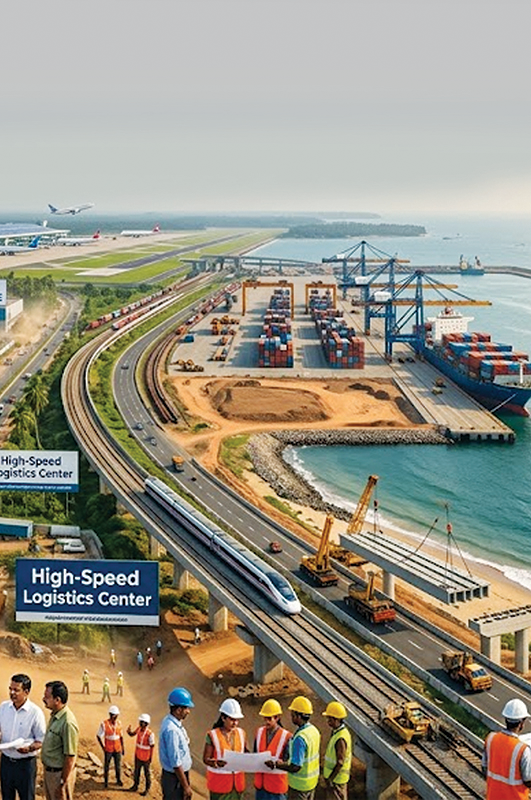
The Government proposes to launch Mission Samudra—a visionary project aimed at elevating the State into a formidable power on the global maritime map within the next five years. To provide rail and road connectivity to Vizhinjam Port, immediate steps will be taken for the construction of the Balaramapuram-Vizhinjam underground railway, the Vizhinjam-Navaikulam Outer Ring Road project etc. The Government will formulate a comprehensive Kerala Maritime Policy to catalyse the development of the State’s four primary non-major ports: Vizhinjam-Kovalam, Kollam, Beypore, and Azhikkal. A comprehensive water transport system interconnecting both major and minor ports will be developed in phases. An amount of Rs. 400 Crore is allotted for Mission Samudra Projects, which includes the Port City.
The government is committed to ushering in a ‘New Age Kerala ’— an era that harmonises economic growth driven by social justice backed by modern, environmentally responsible infrastructure development.
The other major projects proposed in the budget are: Southern Kerala Economic Corridor; various infrastructure development projects; Invest Keralam project; Kerala MSME Growth Scheme; the Kerala Knowledge Valley, a world-class higher education hub etc.
Better Fiscal Management
In the revised budget, a number of measures are proposed to improve state finances through better fiscal management and other measures, making more public funds available for capital investment. The new vision proposals in the budget rely on public and private investment in key infrastructural areas. These measures will give a big push to the development of infrastructure items such as major and minor ports, coastal shipping, shift of goods transport from road to coastal shipping, establishment of economic corridors, large investment in major development projects, development of MSMEs, establishment of a world-class higher education hub etc. The vision proposals also harmonise economic growth driven by social justice, backed by modern, environment-friendly development.
On the whole, the new vision proposals in the revised budget will stimulate the economic development of the state economy, which has been experiencing economic stagnation due to retrogressive policies and persistent fiscal crises over the last decade.