

Where Mountains Meet Monsoon
MONSOON

Prof. Abhilash S.
Director
Advanced Center for Atmospheric Radar Research
Cochin University of Science and Technology
The Western Ghats act as the primary climatic regulator of Kerala, functioning both as a barrier and, through key gaps, as a corridor that allows influences from northern and eastern India to modify local weather. By intercepting moisture-laden winds, the Ghats enhance rainfall, moderate temperature, and sustain high humidity, thereby supporting the state’s rich biodiversity from the high ranges to the midlands and coastal plains. The spatial distribution of rainfall across Kerala is strongly controlled by the altitude and orientation of the Ghats, with the highest rainfall along the windward slopes and a gradual decrease toward the eastern rain-shadow regions. The abundant monsoon rainfall captured by the Western Ghats is stored within the mountain ecosystem and released through an extensive network of 44 rivers, maintaining their perennial nature and supporting the flora and fauna, as well as the lives and livelihoods of over 35 million people. These processes also drive a dynamic system of erosion, transport, and deposition, linking Kerala’s highlands, midlands, and lowlands into an integrated physiographic unit.
From mountain crest to coastal plain, the journey of cloud and river under the monsoon’s rhythm makes Kerala’s climate truly one of a kind.
Kerala receives high annual rainfall of about 2500–3500 mm, mainly due to the southwest monsoon and the orographic effect of the Western Ghats. Around 70– 75% of the rainfall occurs during the southwest monsoon (June– September), followed by 15–20% during the northeast monsoon (October–November), with minor contributions from pre-monsoon showers. Rainfall is highest along the Western Ghats and decreases towards the eastern rain shadow regions. Together, these factors highlight the central role of the Western Ghats in shaping Kerala’s climate, hydrology, and ecological balance.
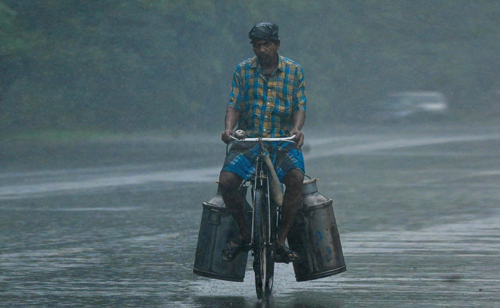 The monsoon is the defining feature of the climate of Kerala, usually arriving around June 1 each year and marking the start of the rainy season. As explained by Colin Stokes Ramage, a true monsoon climate involves a major shift in wind direction between winter and summer—something clearly experienced in Kerala.
The importance of these winds has been recognized for centuries. The ancient Greek text Periplus of the Erythraean Sea describes how the navigator Hippalus understood these seasonal wind patterns, making it possible to sail directly across the Indian Ocean from the Red Sea to ports like Muziris on the Kerala coast. This discovery not only transformed maritime trade but also highlights how closely Kerala’s history and livelihood have been tied to the rhythm of the monsoon.
The South Asian monsoon we experience today is the result of a long geological journey shaped by Plate Tectonics. Over millions of years, the movement of continents, the rise of mountains, and changes in the oceans have all played a role in building the modern monsoon system. A key turning point came about 50 million years ago, when the Indian plate drifted northward and collided with Eurasia. This collision led to the formation of the Himalayas and the uplift of the Tibetan Plateau, which significantly altered atmospheric circulation and strengthened the monsoon.
At its core, the Indian summer monsoon is driven by the contrast in heating between land and sea. As the Sun moves northward during summer, the vast landmass stretching from East Africa to northern India heats up rapidly, creating a strong low-pressure area. In contrast, the surrounding oceans remain relatively cooler, drawing in moisture-laden winds toward the land. While this land–sea temperature difference is the primary driving force, the monsoon’s behavior is further shaped by Earth’s rotation and major mountain barriers like the Himalayas and the Western Ghats, which guide and intensify rainfall patterns.
Kerala’s climate and landscape are deeply shaped by its unique location along the Arabian Sea and the towering Western Ghats. The highlands, formed by the uplifted Western Ghats, are the first to receive the force of the monsoon. Heavy rains here lead to continuous weathering of rocks and soil erosion. The eroded material is carried downhill by numerous rivers, gradually shaping the midlands with rolling terrain and lateritic soils formed through prolonged leaching. Further downstream, these sediments are deposited in the lowlands and coastal areas, creating fertile alluvial plains that support agriculture and settlements. This natural cycle of erosion, transport, and deposition connects Kerala’s landscapes into a dynamic and interdependent system.
During the southwest monsoon, the Western Ghats act as a massive barrier to moisture-laden winds from the Arabian Sea. As these winds are forced to rise along the mountain slopes, they cool and condense, producing intense rainfall, through a process known as orographic precipitation. This is why Kerala receives some of the highest rainfall in India. At the same time, the Western Ghats also block hot winds from the interior, helping Kerala stay relatively cool, humid, and comfortable compared to many other regions.
The monsoon is central to life in Kerala. It replenishes rivers, recharges groundwater, and sustains agriculture. It also supports the region’s rich biodiversity, from dense forests in the high ranges to wetlands and backwaters along the coast.
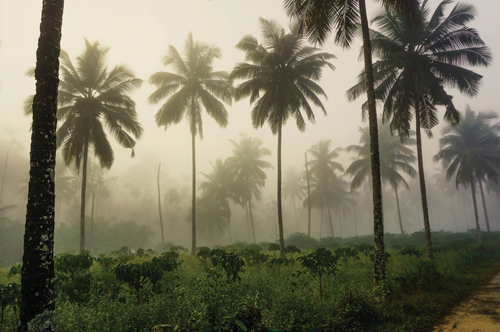 During the hot pre-monsoon months, the Western Ghats shape the weather of Kerala in two contrasting ways. For most of the state, the Ghats act like a barrier, blocking hot, dry winds from the interior and helping maintain humid conditions. But the natural breaks such as the Palakkad Gap and Punalur Gap, acts as corridors. Through these gaps, hot diverging air from the anti-cyclonic circulation move main land flows into Kerala, raising temperatures, reducing humidity at times, and intensifying heat-wave conditions in certain regions. At the same time, the Ghats play a key role in triggering pre- monsoon rainfall. Along their foothills, a “wind discontinuity” often forms where moist winds from the Arabian Sea meet the hot, dry easterly winds coming through the gaps. This collision of air masses forces air to rise, and the mountains further enhance this upward motion. Combined with strong daytime heating, this creates unstable conditions that quickly build towering cumulonimbus clouds. As a result, many areas, especially along the foothills in districts like Kottayam, Idukki, and Pathanamthitta experiences frequent thunderstorms with lightning, thunder, and gusty winds. These short but intense showers, popularly known as “mango showers,” bring the first relief from the heat and play an important role in preparing the land for the coming monsoon and agricultural season.
The Western Ghats modulate the northeast monsoon over Kerala primarily through a rain-shadow effect, as the northeasterly winds lose much of their moisture on the eastern side of the mountains. As a result, Kerala receives less direct rainfall from the northeast monsoon compared to regions on the eastern side. However, the state still experiences rainfall during this period due to moisture picked up from the Arabian Sea, local convective activity, and the influence of cyclonic systems. Easterly waves play a major role in bringing widespread post- monsoon rain, while the Western Ghats enhance this rainfall through orographic uplift and the formation of localized thunderstorms along the foothills. This leads to rainfall that is often uneven, scattered, and intense across South and central Kerala.
With the onset of the southwest monsoon, the Ghats force moisture-laden winds from the Arabian Sea to rise, producing heavy rainfall that defines Kerala’s hydrology and sustains its ecosystems. In the post-monsoon period, they create a rain-shadow effect for northeasterly winds, yet still support localized rainfall through convection and cyclonic influences. Overall, the Western Ghats regulate temperature, humidity, and rainfall distribution, making them fundamental to Kerala’s climate and environmental stability. From mountain crest to coastal plain, the journey of cloud and river under the monsoon’s rhythm makes Kerala’s climate truly one of a kind.