
Onam: Cultivating Prosperity Across Generations
T. Siddique
Minister for Agriculture
As Kerala celebrates abundance, we must honour farmers through fair markets, women-led enterprise, responsible technology and school-based agricultural learning that connects a new generation with soil, food and shared prosperity.
Onam invites us to imagine a society in which prosperity is shared, food is plentiful and every family can celebrate with dignity. That is why the story of Mahabali continues to live so powerfully in our collective memory. It speaks not simply of abundance, but of equality, gratitude and hope. At the heart of that promise are the farmers whose labour sustains our homes, strengthens our communities and keeps alive Keralam’s enduring relationship with the soil.
Our agrarian landscape has shaped our culture, cuisine and way of life for generations. The rice served at the Onasadya, the Nendran banana, the vegetables gathered from farms and homesteads, and the flowers arranged in the pookalam all carry the imprint of human effort and natural abundance.
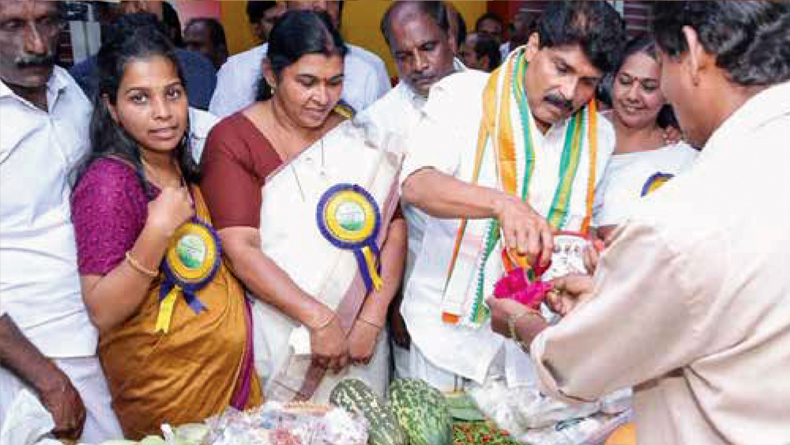
Nearly 2,000 Onam markets are planned across Kerala in partnership with the Vegetable and Fruit Promotion Council Kerala (VFPCK) and HORTICORP, with a proposed outlay of 10.20 crore.
This year, our Government is working to ensure that Onam honours farmers not only in sentiment, but through meaningful support. The Agriculture Department’s special programme seeks to expand the cultivation of vegetables, Nendran banana and marigold while strengthening the connection between production and markets. Nearly 2,000 Onam markets are planned across Kerala in partnership with the Vegetable and Fruit Promotion Council Kerala (VFPCK) and HORTICORP, with a proposed outlay of Rs.10.20 crore. These markets will make fresh produce and value-added agricultural products available at affordable prices while helping farmers secure remunerative returns.
 Women will be central to this transformation. Launched in the context of the International Year of the Woman Farmer 2026, the five-year Krishi Sakhi-Women Farmer Development Programme has an outlay of Rs.3.5 crore. A State-level Women Consortium will bring together women’s collectives, improve access to technology and finance, and support women-led agricultural enterprises.
Special attention will be given to conserving the traditional farming practices and agricultural heritage of tribal communities while improving their access to markets. We will intensify efforts to identify fallow land suitable for cultivation and create stronger pathways for farmers’ produce to reach national and international markets.
Technology must serve this human purpose. An allocation of Rs.1.5 crore has been made for Technology-Driven Agriculture, supporting artificial intelligence, drones, sensors, smart irrigation, precision-farming tools and digital decision-support systems wherever they are practical and beneficial. The Department has begun steps to introduce AI-based technologies across Kerala and aims to substantially expand their adoption over the coming year.
Our agricultural renewal must also begin with the young. Kathiru Agricultural Clubs-short for Kerala Agriculture Technology Heritage and Innovation for Rural Understanding-will connect students with farming, scientific practice, food systems and environmental stewardship. Acclaimed actor Mohanlal brings exceptional strength and visibility to this mission as the Goodwill Ambassador of the Kathiru programme.His inspiring presence will help carry the message of Kathiru into homes across Kerala, encouraging children and families to embrace agriculture with renewed interest, pride and confidence. In the first phase, financial support will be provided to 2,500 schools, with the programme intended to extend across government and aided schools. Each club will include interested students and function with student and teacher nodal leadership, supported through training, monitoring and continued departmental guidance.
The Kanippanthal in Schools complements this effort by linking agriculture with children’s nutritional security. The programme is being implemented under the Fruit Nutrition Garden Scheme of the State Horticulture Mission. In the first phase, fruit nutrition gardens are proposed in 2,921 selected schools. The Agriculture Department will provide saplings free of cost, including mango, jackfruit, guava, Indian gooseberry, sapota, rambutan, mangosteen and passion fruit.
The promotion of farm tourism, supported by an outlay of Rs.50 lakh, provides another path fordiversified rural incomes. Our farms are repositories of biodiversity, indigenous knowledge, food traditions and cultural memory. Responsible farm-tourism enterprises can create employment and supplementary income while allowing visitors to experience rural life.
Together, these measures advance a larger commitment to food security. We want every family to have access to safe, nutritious and locally produced food. This requires stronger farmer producer organisations, reliable market linkages, responsible value addition, household cultivation and farming practices that protect soil, water and biodiversity.
As we welcome Mahabali, let us honour the people who make abundance possible. Let us respect farmers not only in words, but through fair markets, responsible consumption and sustained public support. Let us protect the soil and water that future generations will inherit and give women and young people the confidence to build livelihoods in agriculture.
May this Onam bring happiness to every home, hope to every farmer and strength to every family. May it renew our resolve to build a more equal, compassionate, food-secure and self-reliant Keralam.
Onashamsakal to all!