
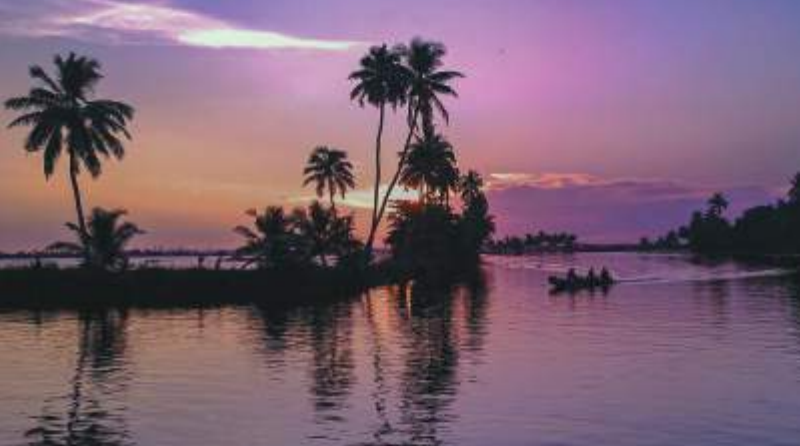
Kuttanad: A Timeless Waterbound Landscape
DIVERSE LANDSCAPE

K.V. Divyasree
Writer
Kuttanad, often called ‘The Rice Bowl of Kerala,’ is a unique and picturesque region located around the vast Vembanad Lake. Its formation and existence is defined by a rare phenomenon: it is one of the few places in the world where farming is carried out successfully at 1.2 to 3 meters below sea level.
A Landscape Below Sea Level
Kuttanad’s landscape is defined by its unusual topography, with vast stretches of land lying up to two meters below sea level. This creates a fascinating environment where land and water coexist in delicate balance. The area is interwoven with a network of rivers, canals, lakes, and backwaters, forming a water- dominated ecosystem. Vembanad Lake, the longest lake in India, acts as the lifeline of Kuttanad. The region’s wetlands are rich in biodiversity and are recognised as part of the Vembanad-Kol wetland system, which is of international ecological importance. The interplay of water and land gives Kuttanad a distinctive identity that sets it apart from other agricultural regions.
Kuttanad stands as a unique geographical landscape where land and water exist in delicate balance, shaping a distinctive identity that makes it one of Kerala’s most remarkable natural settings.
Reclaimed Deltaic Formation
Kuttanad was not always dry land. A significant portion of the region was originally part of Vembanad Lake and shallow marshlands. Over centuries, but specifically during the 19th and 20th centuries, large areas were reclaimed through human intervention. Local farmers created “Padasekharams” (paddy fields) by constructing massive bunds and embankments to keep the tidal waters out. Farmers have reclaimed land from the lake by constructing bunds (embankments) using mud dredged from the lakebed. These ‘padashekharam,’ are enclosed areas where water is pumped out to make cultivation possible. Since these fields lie below the water level, continuous efforts are required to prevent flooding.
Traditional water wheels have largely been replaced by modern pumping systems that help regulate water levels efficiently. This method of below-sea-level farming showcases the ingenuity and resilience of the local farmers. Paddy is the principal crop grown here. Indigenous varieties such as ‘Pokkali,’ which can tolerate salinity and waterlogging, are particularly significant.
Often referred to as the “Netherlands of the East,” Kuttanad stands out for its uniquely inverted geography, unlike most coastal regions. This low-lying delta is shaped by four major rivers—the Pamba, Meenachil, Achankovil, and Manimal—which deposit rich alluvial silt into the basin, creating fertile but flood-prone lands that lie below sea level. To sustain agriculture in such conditions, the region depends on an ingenious system of traditional and modern water management practices. Bio-bunds, constructed using river mud, coconut fiber, and clay, form protective embankments around polders, while continuous dewatering through pumping mechanisms removes excess water from the fields into the surrounding canals and backwaters. Together, these methods enable cultivation in one of the most challenging yet productive landscapes in India.
The region is nourished by four major rivers—Pamba, Meenachil, Achankovil, and Manimala. These rivers flow through the region and eventually drain into Vembanad Lake, maintaining a delicate hydrological balance. These rivers bring nutrient-rich sediments that enhance soil fertility, making the land highly suitable for cultivation.
Backwater Tourism and Rural Charm
The daily life of the people reflects a deep harmony with nature, as they adapt to the rhythms of water levels and seasonal changes. The region is a major attraction for both domestic and international tourists who seek to experience Kerala’s famous backwaters. A journey through Kuttanad’s backwaters offers a unique glimpse into this lifestyle—lush green paddy fields, narrow canals, coconut groves, and small villages create a serene and captivating environment. Eco- tourism initiatives have also gained importance, promoting sustainable travel while preserving the natural environment. The combination of natural beauty and cultural richness makes Kuttanad a key contributor to Kerala’s tourism industry.
A Globally Recognised Agricultural Heritage
Recognised as a Globally Important Agricultural Heritage System (GIAHS) by the Food and Agriculture Organisation, Kuttanad exemplifies an extraordinary model of sustainable human adaptation to a challenging environment. Its below-sea-level farming system, shaped by centuries of traditional knowledge and community-driven water management, has transformed a fragile wetland into a highly productive agricultural landscape while preserving its natural hydraulic balance. Rather than altering or degrading the ecosystem, local practices have worked in harmony with sediment deposition and water flow, making Kuttanad a rare and globally significant example of how cultural heritage and ecological wisdom can coexist to ensure both productivity and sustainability.