
Evolving Society, Growing Freedom
PRIYADARSHINI

Niranjana R.S.
Second year M.A. JMC
SRM University, Chennai
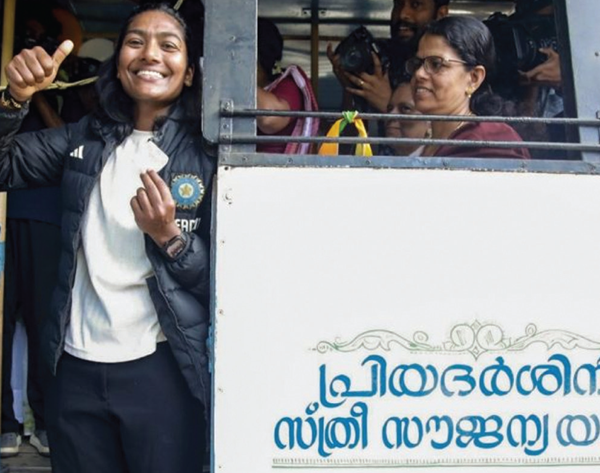
Kerala’s Priyadarshini Scheme is transforming everyday travel into economic relief, mobility, and empowerment for women statewide.
From students travelling to college to employees commuting to work, KSRTC buses connect thousands of women across Kerala to opportunities and essential services every day. For many of them, the journey no longer comes with the daily worry of setting aside money for bus fare. The State government’s Priyadarshini Scheme, which provides free travel on KSRTC ordinary services, has emerged as a significant step towards economic relief, social inclusion, and women’s empowerment. Unlike many welfare programmes that target specific income groups, the Priyadarshini Scheme is available to women of all ages regardless of their financial background. It also extends benefits to members of the transgender community travelling in ordinary KSRTC buses throughout the state. The initiative covers daily commuter routes, intra-district and inter-district services, as well as rural and semi- urban routes, ensuring that people from different regions can benefit from the programme.
The significance of the scheme becomes evident when viewed through the daily operations of KSRTC depots. Take for instance the case of Neyyattinkara depot in Thiruvananthapuram, which operates a large number of ordinary bus services and records a high volume of passengers on these routes. Around 48 to 55 ordinary services are frequently availed by commuters. A majority of the passengers travelling on these buses are women, including students, employees, and homemakers.
KSRTC employee Renjith, says “If you observe the passenger flow in ordinary services, especially in depots like Neyyattinkara and Kattakada, you can clearly see that a large number of the commuters are women. These buses are an essential part of their daily lives.
The Priyadarshini Scheme has reduced the financial burden on many of them and has made public transport more accessible”. The benefits of the scheme are not just statistical but deeply personal. The reduction in transportation expenses allows women to allocate money towards education, household needs, savings, and other essential expenses. Estimates suggest that daily commuters can save between ₹800 and ₹1,000 per month, resulting in annual savings of up to ₹12,000. Such savings can make a significant difference in the financial stability of households. The benefits of the Priyadarshini Scheme are already being felt by regular commuters.
Anamika, a daily passenger travelling from Kattakada to Kazhakootam, shared how the initiative has eased her financial burden-“For someone travelling such a long distance regularly, the expenses added up quickly, and therefore the scheme has helped me save a considerable amount every month.”
The impact of the scheme is equally evident among students pursuing higher education. Amritha, a college student who travels daily from Neyyattinkara to Karamana, spoke about the difference the initiative has made in her life. The distance between her home and college is nearly 30 kilometres, making transportation a major recurring expense. “Before the scheme was introduced, travelling to college every day was expensive. Now I don’t have to worry about spending money on bus fares. This scheme has helped me a lot.”
By reducing transportation expenses, the government helps create greater opportunities and mobility for women from different economic and social backgrounds.
For students like Amritha, the initiative is not merely a concession; it is a support system that makes education more accessible and affordable. Another student, Ananya, who travels daily from Balaramapuram to S.N. College, Chempazhanthy, also highlighted the benefits of the programme.
“The travel expense was a regular burden for me; with the help of this scheme, I am able to save money, and travelling has become much easier.” Ananya also believes that the benefits extend beyond students. “This scheme is equally beneficial for working women who depend on public transport every day,” she added.
The scheme has also made a difference in the lives of homemakers who depend on public transport for their daily activities. Saritha, a homemaker, shared her views – “As a homemaker, the Priyadarshini Scheme has been extremely beneficial for me. Free bus travel has reduced my transportation expenses and allows me to travel more independently and confidently. This scheme is a great support, especially for homemakers like me who do not have a regular source of income,” she said. There is an often-overlooked aspect of public transportation. For women who do not earn a regular income, even small travel expenses can become a burden. The scheme enables them to visit hospitals, markets, government offices, and family members without worrying about transportation costs. In doing so, it enhances both their mobility and independence.
Despite all these benefits, the scheme faces financial challenges. Government estimates that its implementation could result in additional annual burden for KSRTC. However, the government has maintained that the social benefits of the initiative outweigh the costs.
The government has maintained that the social benefits of the initiative outweigh the costs.
The Priyadarshini Scheme represents more than free bus travel. It reflects a commitment to creating a more inclusive and accessible public transport system for women. As KSRTC buses continue to carry women across cities, towns, and villages, the Priyadarshini Scheme stands as a reminder that access to affordable transportation can open doors to education, employment, independence, and opportunity. For many women across Kerala, every free bus journey is not just a ride, it is a step towards empowerment.