
BOAT RACES Where Art and Muscle Power Synergise

Dr. Nedumudi Harikumar,
Writer
The boat race is a great sports event that Kuttanad has gifted to the world. It can also be described as a leisure-time activity and form of self-expression designed by a people who combat adverse life circumstances. Not so long in the past, small boats were the only means of transportation in this region full of rivers, canals and water-logged paddy fields. There were plenty of canoes in Kuttanad that could be rowed by one, two or four persons. And then there were various, larger, canopied barges, called kettuvallams, company vallams and valavarayan vallams, for transporting people and goods. Maybe the boat race originated when rowers playfully started competing with one another in order to gain relief from the tedium of their daily chores.
 Water sports in Keralam begins on the Moolam asterism of the Malayalam month of Midhunam [June-July] on the Champakulam water channel that runs through Kuttanad in Alappuzha district. This boat race is connected to a legend about the deity of the Sri Krishna Swamy temple in Ambalapuzha. The months of Idavam, Midhunam and Karkadakam [mid-May to mid-August] constitute a period of deprivation, characterised by poverty and attendant troubles but, strangely, it is also a time when boat races, with all their fun and festivities, begin. The enthusiasm of this indigenous water sport reaches its zenith during Onam festival in the month of Chingam [Aug.-Sept.].
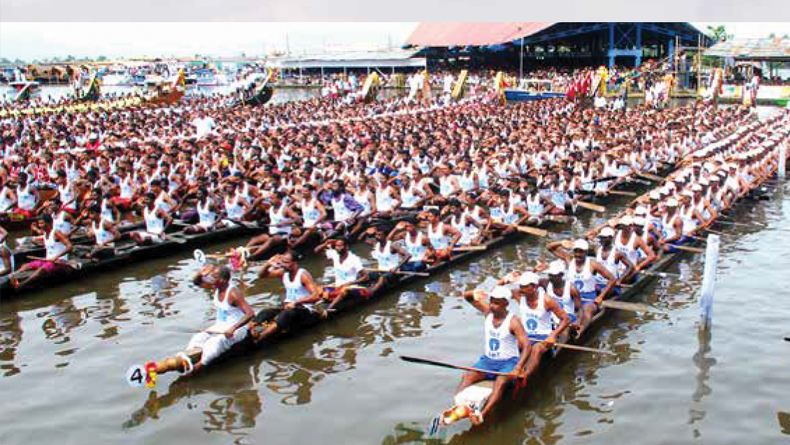
Every year, the world-famous Nehru Trophy Boat Race – described as the Olympics on the Ripples – takes place on the Punnamada lake in Alappuzha town. It commemorates the visit of India’s first Prime Minister Pandit Jawaharlal Nehru to Alappuzha on the Second Saturday of August 1952. Snake boats had arrived at Punnamada as part of a formal welcome accorded to Nehru. Excited on seeing the Nadubhagam snake boat gliding by, Nehru jumped into it, sending its rowers into a tizzy of joy. Nehru himself instituted the trophy to commemorate his visit to Alappuzha, and since then the boat race has been conducted every year, on the Punnamada lake on the Second Saturday of August. In the initial years, it was known as the Prime Minister’s Trophy.
The snake boat is the emperor of all racing boats. The sight of these boats zipping over the ripples of the lake, like black snakes, is one of unparalleled beauty and gives inexplicable joy. A single snake boat can accommodate more than 100 individuals, including the rowers, the steersmen, the rhythm-keeper and the choristers. Each boat in Kuttanad and Aranmula is owned, designed and maintained by a region. There are numerous regions, a few of which are Kavalam, Nadubhagam, Champakulam, Aanakkari, Paayippad, Cheruthana, Thaayankari, Koduppunna, Pulinkunnu and Kaarichaal. In the course of time, the snake boats of some of these regions that disintegrated have been renewed, and even given new shape.
As the season of the boat race begins, the people of Kuttanad talk about nothing other than boats and races. When the rehearsals start, the level of enthusiasm soars. Betting and raucous calls reach a feverish pitch, making the atmosphere vibrant and frenzied. The strongest among the youth of the area, cutting across all differences of caste, religion, class and race, are selected as rowers. Winning a creditable victory is a matter of prestige as far as each region is concerned. And to achieve it, the people are prepared to sacrifice their all, be it their own health or their savings.
Vanchipaattu or boat songs form the literary component of the boat race. Among them, ‘Kuchelavrittam’ vanchippaattu of Ramapurathu Warrier is the most prominent. Set in Nathonnatha metre, it is famous not only in Kuttanad but in the entire state of Keralam. The winners return home, singing this song:
Kuttanadan punjayile, kochu penne, kuyilalaale,
Kottuvenam, kuzhal venam, kuravavenam.
Varavelkaanaalu venam, kodithoranangal venam,
Vijayashree laalitharaayi varunnu njangal . . .
[O young girl on the punja fields of Kuttanad, O cuckoo!
Let’s have drumbeats, pipe music and ululation.
Let’s have welcoming crowds and gay festoons,
To receive us, as we come in victory . . .]
Boat songs are primarily meant to relieve the strain of the rowers, and they are set to different kinds of metres. Vocables are also used for the same purpose:
Thithithaarathithitheiy
Thitheithakatheiytheiythom
Thaathaamthatheiyyam
Thitheiyyamtheiythom . . .
 While these are sung in slow tempo, there are other vocables like ‘Ayyadapoyedaa . . .” which are fast-paced. A thick wooden plank called vedithadi is placed right in the middle of a snake boat, and the rhythm-keeper uses a long pole, the height of an adult male, to pound on it in order to keep the time. The rest of the choristers stand around him. The rowers in a snake boat have their special places. Those seated at the highest point of the boat play a major role in steering the direction of the vessel. As they plow the waters of the lake and the river, they send high arcs of water drops in opposite directions, and the beauty of the spectacle is simply indescribable. Their discipline, athletic power and stamina have to be at the highest level.
By the time they appear for the competition, especially for major events like the Nehru Trophy Boat Race, they would have put one month of intense training and practice behind them. And when a team completes its participation in an event, from the first rehearsal to the final race, it would have spent lakhs of rupees. In races like the Nehru Trophy, government grants are a great source of support to the participants. Although certain other boat races also have government sponsorship, most are conducted with the help of generous funds from individuals and residents of each region. Despite all the effort and expense, nothing whips up as much enthusiasm and cheer in the world as this particular sports event. Small wonder that Nehru Trophy Boat Race has won the sobriquet ‘Olympics on the Ripples’. It is also a form of sports that symbolises the gallop of human life.