
Forging a United Front against Narcotics
Our vision is clear: a Kerala where every child grows up free from the threat of narcotics, where communities remain secure, where organised drug syndicates are relentlessly pursued, and where the rule of law prevails without exception.

Ravada A Chandra Sekhar IPS
Director General of Police, Kerala
The fight against narcotic drugs has emerged as one of the defining law enforcement challenges of our time. Drug trafficking today is no longer confined by geographical boundaries or conventional criminal networks. It has evolved into a sophisticated transnational enterprise that exploits technology, transport corridors, financial systems, and vulnerable communities. The consequences extend far beyond crime, threatening public health, social harmony, economic stability, and, most importantly, the future of our youth.
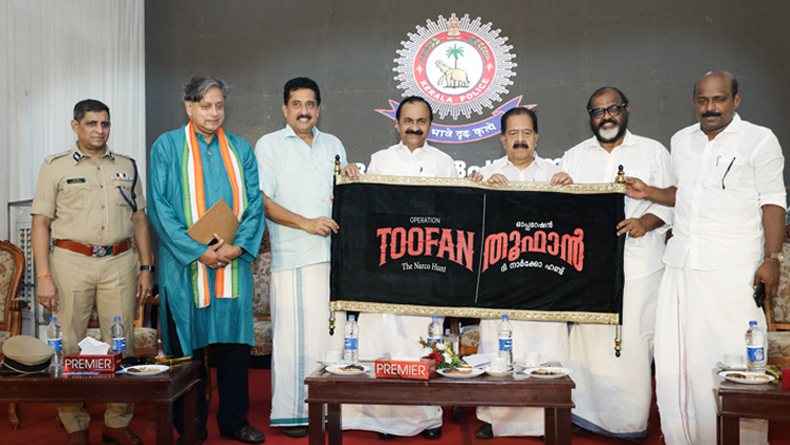
Recognising the gravity of this challenge, Kerala has adopted a comprehensive and uncompromising approach to combating the drug menace. Under the leadership of the Government of Kerala and the Home Department, the Kerala Police has launched Operation Toofan: The Narco Hunt, India’s largest coordinated anti-narcotics initiative. More than an enforcement campaign, Operation Toofan represents a strategic framework that integrates intelligence, technology, inter-agency coordination, and interstate cooperation to dismantle narcotics networks at every level.
South Zone Meet

A landmark milestone in this mission was the Inter-State Coordination Meeting of Police Chiefs from South Indian States, held at the Kerala Police Headquarters in Thiruvananthapuram. Convened by Home Minister Ramesh Chennithala, the meeting marked a new chapter in collaborative policing against narcotics and cross-border organised crime.
The conference brought together police leadership from Kerala, Tamil Nadu, Karnataka, Puducherry, Telangana, and Andhra Pradesh, along with senior officials representing key central enforcement agencies, including the Narcotics Control Bureau (NCB), Directorate of Revenue Intelligence (DRI), Customs, Subsidiary Intelligence Bureau (SIB), and the Railway Protection Force (RPF). The participation of these agencies reflects a shared understanding that the drug menace cannot be defeated through isolated efforts. It demands coordinated intelligence, seamless communication, and synchronised operational responses.
Former Director General of Police and Advisor to Home Minister A. Hemachandran IPS delivered the keynote address, highlighting the changing dynamics of organised crime and the urgent need for integrated enforcement strategies. North Zone Inspector General and Operation Toofan Nodal Officer Putta Vimaladitya IPS presented the operational framework of the project, outlining its objectives, enforcement methodologies, intelligence-sharing mechanisms, and coordination protocols among participating agencies.
Towards Concrete Measures
The significance of this conference lies not merely in the exchange of ideas but in the institutional mechanisms it established for future cooperation. One of the most important decisions of the meeting was the creation of a permanent interstate coordination system involving the five South Indian states. Under this framework, each participating state will designate officers above the rank of Superintendent of Police as dedicated nodal officers for Operation Toofan.
Equally important, corresponding nodal officers will be appointed within central agencies such as the Narcotics Control Bureau, Directorate of Revenue Intelligence, Customs, and the Railway Protection Force. This network of nodal officers will facilitate real-time intelligence sharing, coordinated investigations, joint operational planning, and rapid response mechanisms across state boundaries. Such institutional arrangements significantly reduce operational delays and strengthen collective enforcement capabilities.
Drug traffickers increasingly operate through complex interstate supply chains, using multiple transport modes to evade detection. Kerala, given its extensive coastline, international airports, railway network, and interstate road connectivity, requires constant vigilance against attempts to transport narcotic substances into the state. Recognising this challenge, the conference resolved that joint operations involving South Indian states and central agencies would soon commence to identify and block the principal trafficking routes leading into Kerala.
The operational scope of Operation Toofan extends across all major modes of transportation. Surveillance and enforcement activities will be intensified at interstate borders, highways, railway stations, airports, seaports, inland waterways, and other vulnerable transit points. The objective is not only to intercept consignments but also to dismantle the organised criminal syndicates responsible for financing, transporting, and distributing narcotic substances.
Modern drug trafficking has also migrated into the digital domain. Criminal networks increasingly exploit online platforms, encrypted communication channels, social media applications, courier services, and e-commerce logistics to conceal their activities. Operation Toofan recognises this evolving threat landscape. Accordingly, special surveillance and targeted enforcement measures will focus on courier-based trafficking, digital transactions linked to narcotics, and emerging technology-enabled methods employed by organised criminal groups.
Strengthening Enforcement
The misuse of prescription medicines with addictive potential presents another growing concern. To address this challenge, the Government has announced stricter regulation of medicines that require valid medical prescriptions. Joint inspections by the Police Department and the Health Department will strengthen oversight of medical stores and pharmaceutical distribution channels, preventing the diversion of controlled medicines into illegal markets while safeguarding legitimate healthcare access.
At the district level, Kerala’s well-established District Anti-Narcotic Special Action Force (DANSAF) will be further strengthened as a permanent enforcement mechanism. DANSAF has already demonstrated the effectiveness of coordinated district-level action by integrating intelligence gathering, preventive policing, and swift operational responses. Strengthening this institutional framework will enhance local enforcement while ensuring consistent implementation of anti-narcotics strategies throughout the State.
The criminal justice response to narcotics offences must be both effective and timely. Recognising the importance of speedy prosecution, the Government has announced the establishment of two additional Special Courts under the Narcotic Drugs and Psychotropic Substances (NDPS) Act in Thiruvananthapuram and Ernakulam. Furthermore, the State will implement the Central Government’s directive to establish ten additional NDPS Courts, significantly enhancing judicial capacity to ensure faster disposal of drug-related cases and stronger legal deterrence.
Kerala’s well-established District Anti-Narcotic Special Action Force (DANSAF) will be further strengthened as a permanent enforcement mechanism
The conference also reaffirmed that anti-narcotics enforcement and maintenance of law and order remain complementary responsibilities. The Government has made it unequivocally clear that there will be no compromise in maintaining public order while simultaneously intensifying operations against narcotic crimes. Professional policing demands both proactive crime prevention and effective enforcement, and Operation Toofan embodies this balanced approach.
|
Significant Steps
|
|
Meeting Attended by
|
Invoking a Collective Spirit
While enforcement remains a critical pillar, experience has repeatedly shown that policing alone cannot eliminate the narcotics problem. Sustainable success requires active participation from every segment of society. Families, educational institutions, local self-government bodies, healthcare professionals, community organisations, media, and responsible citizens all have indispensable roles in identifying risks, supporting prevention programmes, promoting awareness, and protecting vulnerable young people from substance abuse.
Operation Toofan therefore represents more than a policing initiative-it is a societal movement. It seeks to create an environment where intelligence flows seamlessly between agencies, institutions work collaboratively, communities remain vigilant, and criminal organisations find no safe space to operate. By integrating technology, professional investigation, legal enforcement, preventive education, and public cooperation, the initiative adopts a truly holistic approach to combating narcotics.
The Government will establish two additional Special Courts under the NDPS Act in Thiruvananthapuram and Ernakulam.
The successful conduct of the coordination meeting itself demonstrated the spirit of partnership that defines this mission. The presence of senior police leaders from neighbouring states and high-ranking officials from multiple central agencies underscored the collective commitment to protecting society from the devastating impact of narcotic drugs. Their participation reflected a shared recognition that organised crime does not respect administrative boundaries, and therefore our response must likewise transcend jurisdictional limitations.
Operation Toofan signals Kerala’s determination to remain at the forefront of modern, intelligence-led policing. It exemplifies how strategic leadership, institutional coordination, and technological innovation can be combined to address one of the most complex security challenges confronting our nation today.
Through strong interstate cooperation, unwavering political commitment, professional policing, and active public participation, Operation Toofan will continue to strengthen our collective resolve to safeguard future generations.
The fight against narcotics is not the responsibility of the Police alone; it is the responsibility of society as a whole. Together, united in purpose and unwavering in commitment, we can build a safer, healthier, and drug-free Kerala-setting an example for the entire nation.