
Listening. Leading. Changing.
Roji M. John / U. Shaiju
In an exclusive interview with Kerala Calling, Minister for Higher Education Roji M. John shares his vision and hopes for the future of higher education in Keralam, and speaks about the opportunities and challenges in shaping a stronger, more future-ready education system.
Q: How did your experience as the Member of Legislative Assembly for the last decade prepare you for the responsibility of leading the Higher Education Department?
Public life allows you to understand society from very close quarters. As an elected representative, you meet people from different walks of life and listen to their problems, expectations and concerns directly. You also get to understand how government policies are actually perceived at the grassroots level. This difference in perspectives is often vital in higher education. A policy document may look promising from an administrative perspective, but its reality can feel entirely different to a student in a classroom, a teacher in a college, a parent financing his child’s education, or a researcher searching for essential resources.
As the Minister for Higher Education, I will strive to incorporate all these perspectives into policymaking.
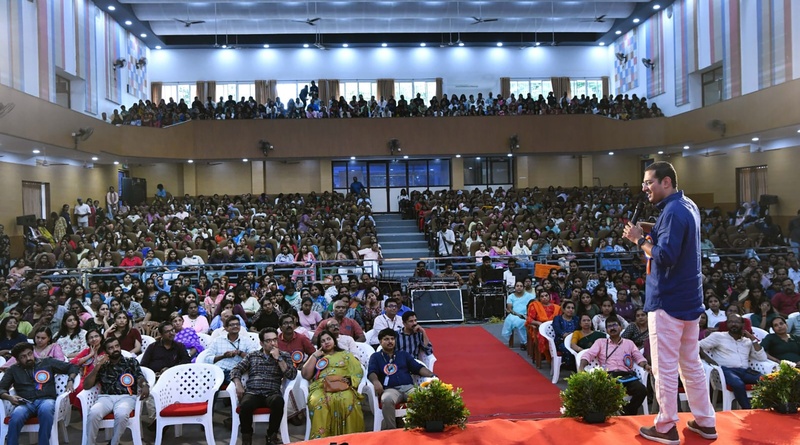
Q: You place considerable importance on direct interaction with students. Why do you consider this important?
Students are among the most important stakeholders in higher education. We can draft policies from behind closed doors, but if we fail to understand the aspirations of the students, the gap between policy and reality will only widen.
Whenever I interact with students, I try to create an environment where they feel comfortable.
They talk about academic pressure, examinations, admissions, infrastructure, transportation, hostels, scholarships, internships, employment opportunities, technology and even their dreams for the future beyond Keralam.
They often draw our attention to practical issues that may not always come to our attention through official reports or administrative channels. When a student opines that a particular procedure is complicated, our responsibility is not merely to explain why the procedure exists. We must also ask whether that procedure itself can be simplified.
That is how a student-centred administration should function.
Recently, when students raised concerns regarding certain aspects of engineering admissions, we examined the issue from their perspective and took steps towards making the admission process more student-friendly.
This kind of responsive governance is what we need to institutionalise.
Q: Keralam has achieved significant progress in expanding access to higher education. What should be the next target?
The next transition must be from access to excellence.For decades, the State of Keralam has been at the forefront in ensuring affordable quality education to our students. While sustaining these achievements, it is imperative that we now turn our focus to the next-generation challenges faced by the higher education sector.
Are our institutions equipped to compete at global standards? Are our students prepared for emerging employment sectors? Are our universities producing high-quality research? Can we build stronger connections between education and industry? Are our campuses encouraging innovation and entrepreneurship? Are our students getting sufficient international exposure? These are the questions that will define the next phase.We need to build a higher education system that is comprehensive, innovative, research-driven, technology-friendly and globally connected.
Q: Government colleges have a central role in Keralam’s higher education system. What is your approach towards strengthening them?
Government institutions are at the heart of the social character of Keralam’s education system.They play a crucial role in ensuring access to quality higher education for students from various social and economic backgrounds.
That is why infrastructure development in government colleges and universities becomes a high priority for the government. Our vision includes setting up modern classrooms, laboratories, libraries, digital facilities and student amenities suitable for a contemporary academic ecosystem. But infrastructure is only one part of the equation. To truly become centres of excellence, institutions also need excellent teachers, strong academic programmes, a vibrant research culture, an effective student-support system and an environment that encourages innovation.
Government institutions should not be chosen by students merely because they are affordable. Our goal is to make them institutions that students would choose for their quality, opportunities and excellence.
Q: Looking ahead, what sort of academic culture do you expect to see across colleges and universities in Keralam?
Our campuses should become spaces of curiosity, creativity and dialogue.
A university or college should not be merely a place where students attend classes and prepare for examinations. Students should be encouraged to ask questions, challenge ideas, conduct experiments, participate in research, engage with society and develop their own perspectives.
We also need to give greater importance to interdisciplinary learning.
Modern education cannot be confined to a single academic discipline. Climate change, artificial intelligence, healthcare, urbanisation, sustainable development and emerging technologies require collaboration across multiple fields.
Our institutions must therefore become more open, integrated and collaborative.
Q: Employment has always been a major concern among the youth of Keralam. How should higher education respond to a rapidly changing job market?
I think there has never been another time in which the nature of work has changed so rapidly. Artificial intelligence, automation, robotics, biotechnology, data science and renewable energy are creating new opportunities while also transforming existing sectors.
Our education system must respond to this reality. We need stronger industry-academia collaboration, greater opportunities for internships and skill development, entrepreneurship programmes and projects connected to real-world work environments. At the same time, we should not reduce education merely to employability. Students also need critical thinking skills, communication skills, creativity, ethical awareness and the ability to learn throughout their lives. Perhaps the most important skill for the future will be the ability to upskill and learn continuously.
Q: With research and development increasingly driving global economies, what is your vision for strengthening research-oriented learning in Keralam?
Keralam has enormous intellectual potential. We have talented students, researchers and teachers. What we need to create is a stronger research ecosystem in which that talent can flourish. Our universities should be encouraged to become stronger centres of research through the sharing of resources and collaboration between institutions and different academic disciplines.Research must also connect with society.
Keralam faces several unique challenges and opportunities relating to climate change, coastal issues, public health, an ageing population, agriculture, tourism, urban development and technology. Our universities should generate knowledge and technology capable of addressing these challenges. At the same time, we must encourage research and widen the scope of research, understanding its global relevance. Our goal should be to make Keralam a state where excellent research leads not only to publications, but also to innovation, entrepreneurship and social transformation.
Q: You have spoken about creating a ‘Knowledge Valley’ to navigate the transformation to a Knowledge society. How do you expect this vision to materialise?
A knowledge society is one in which knowledge becomes a major driver of social and economic development.Keralam already has a strong foundation for this. What we need is an integrated ecosystem in which universities, research institutions, industries, start-ups, students and government work together. ‘The Knowledge Valley’ will offer a single umbrella to integrate and disseminate the fruits of technological innovation in a way that benefits all stakeholders. Research parks, innovation ecosystems, modern learning opportunities, emerging technology initiatives and new forms of cross-sector collaboration are all part of this vision.
Q: What should Keralam’s position be in the global higher education landscape?
Keralam must become more global in its outlook. Internationalisation means bringing global academic standards, international collaborations, faculty exchanges, joint research, international programmes and global experiences into our institutions. Our students should be able to engage with the world while remaining rooted in Keralam.
At the same time, we should create an environment that attracts students and researchers from other states and from other countries. With its academic talent, social progress and high quality of life, Keralam has enormous potential to emerge as an important higher education destination.
Q: Technology is transforming education. How should Keralam respond to this change?
We must embrace technology, but we must do so intelligently.
Artificial intelligence will have a significant impact on teaching, learning, research and administration. It can support personalised learning, strengthen research and expand access to knowledge. But technology cannot replace teachers. Education is not merely about transferring information. It is also about guidance, empathy, dialogue, values and human relationships. Therefore, we need to create an education system that adopts technology, but is fundamentally human-centred.
Students must learn to use AI responsibly and creatively. At the same time, they must retain the ability to think independently and evaluate information critically.
Teachers should have opportunities to update their knowledge, engage in research, learn new teaching methodologies and understand emerging technologies.We need to create an academic culture in which teachers themselves continue to learn throughout their careers.
Q: How can Keralam ensure that equity and social inclusion remain central as its higher education sector undergoes modernisation?
Inclusion is a fundamental element of Keralam’s educational model.
Students from different social and economic backgrounds must have meaningful access to higher education and to the opportunities available within it.But inclusion cannot end with admission.
Students must also have access to infrastructure, technology, scholarships, academic support, counselling, research opportunities, internships and career-oriented programmes. The goal is not merely to bring students into institutions. It is to ensure that every student has a genuine opportunity to succeed.
Q: Looking back at your journey from student activist to public representative and now Higher Education Minister, what is the common thread connecting all these stages?
As a student activist, I worked among students. As a public representative, I worked with people in my constituency and beyond.Today, as a Minister, I have the opportunity to work on policies that can influence an entire generation.
The scale of responsibility has changed, but the fundamental responsibility has not.
It is still about listening, understanding problems and trying to find solutions.
My student years taught me that leadership begins with listening. Public life strengthened that lesson. My present responsibility has made it even more relevant.
Q: Finally, what is your larger vision for the future of higher education in Keralam?
I want to see a Keralam where every young person has the opportunity to access quality higher education, regardless of their social or economic background.Our government institutions should become centres of excellence.
Our universities should become stronger centres of research and innovation.
Our students should become globally competitive while remaining socially responsible.Industry and academia should work more closely together.
Technology and artificial intelligence should become instruments of empowerment.
Above all, our young people should have the confidence that they can build their future in Keralamitself.Keralam should not merely be a state that produces educated young people. We should become a state that produces creators of knowledge, innovators, researchers, entrepreneurs, professionals and responsible citizens.
Education should not be viewed merely as a means to employment. It should become the foundation of individual freedom, social progress and economic development, helping Keralam evolve into a global knowledge society. My own journey began on a college campus.That is why I have a deep understanding of the transformative power education can have in an individual’s life.
A campus can change the direction of a person’s life. A strong higher education system can change the direction of an entire society.