
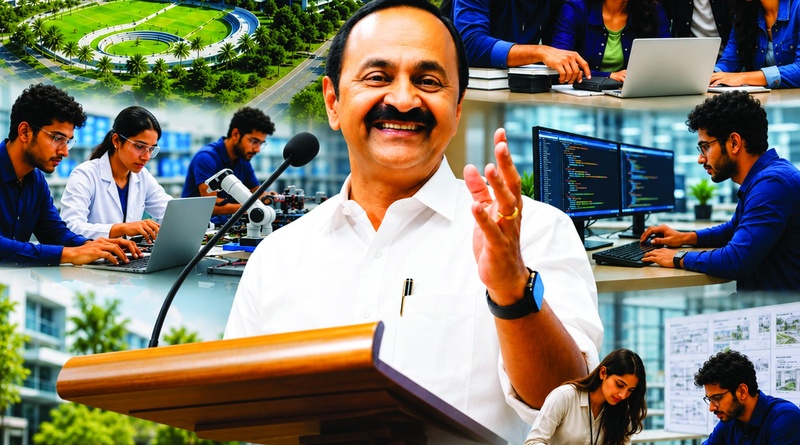
Learning to Lead
V. D. Satheesan
Chief Minister
Reimagining Higher Education for a New Keralam
Keralam’s greatest strength is not merely its natural resources or geography; it is its people. The importance given to education across generations has played a defining role in placing Keralam at the forefront of India’s social development. But in a rapidly changing world, we cannot move forward by relying only on the achievements of the past. We must rethink the purpose and direction of higher education to meet the challenges of a new era.
Higher education can no longer be viewed simply as the final stage of acquiring a qualification. It must become an environment where the abilities of young people are recognised, nurtured and transformed into opportunities for themselves, for society and for the wider economy.
One of the most important questions before Keralam today concerns the future of its young people. The success of our education system cannot be measured only by the number of educated young people who leave the state in search of opportunities. Our young people must have the freedom to explore the world, but they must also have compelling reasons to make Keralam a place where they can build their dreams.
For that to happen, we must change the way we perceive our campuses. Universities and colleges should not exist as isolated academic spaces. They must become more deeply connected to the social and economic life of Keralam. We should ask what a university can contribute to the development of its region, and how a college can help shape the future of the community in which it is located.
Keralam’s future cannot be built only around young people seeking employment. We must also nurture a generation capable of creating employment. An idea born in a classroom should have the opportunity to become an enterprise. A research discovery should have the potential to evolve into an industry. A university campus should be capable of becoming a centre of new economic activity.
This is not simply about strengthening the relationship between industry and education. It is about creating a deeper relationship between our higher education institutions and society itself. Research and academic work must engage more closely with the real challenges confronting Keralam.
From waste management to elder care, from urban development to climate change, many of Keralam’s challenges require the intervention of knowledge, research and innovation. Our universities should become places where these challenges are studied seriously and where practical solutions are developed.
At the same time, the purpose of higher education cannot be reduced to economic growth alone.Education must create people who are capable of thinking. It must nurture individuals who can question, respect differences of opinion, make decisions based on evidence and remain conscious of their responsibilities towards society. Such citizens are essential to the future of democracy. Education, therefore, is not merely a process of transferring knowledge; it is also a process of shaping citizens.
Public education and public institutions have played a vital role in Keralam’s social progress. Strengthening government higher education institutions, therefore, cannot be seen merely as an infrastructure development exercise. It is an investment in the continuity and strength of Keralam’s social democracy.
Keralam must never become a society where access to the best educational opportunities depends primarily on economic privilege. A child from an ordinary family must have the opportunity to rise as far as their talent and determination can take them. Opening the doors of education is only the beginning; we must also ensure that every student who enters those doors has a genuine opportunity to progress.
The world is now undergoing a profound transformation. Technology is changing the very nature of human life and work. Entire sectors are evolving. New professions are emerging, while some traditional occupations are disappearing.
An education system that fears change can never lead the future. But while embracing technology, we must also preserve the human values that give education its deeper purpose. Empathy, creativity, ethical awareness, social responsibility, collaboration and independent thought are qualities that technology cannot replace.
The education of the future must therefore be technologically advanced, yet deeply human. Our universities must be more open to the world. But internationalisation should not mean simply copying models from elsewhere. Keralam must learn from global experience while developing solutions rooted in its own social realities and, in doing so, create models that the world can learn from.
Young people who leave Keralam to study or work abroad should not automatically be viewed as a sign of failure. Our global generation can be one of Keralam’s greatest strengths. At the same time, our higher education institutions should become bridges that bring global knowledge, ideas, talent and investment back to Keralam.
The next phase of Keralam’s development will not be defined only by more roads, buildings and physical infrastructure. It will be defined by greater knowledge, greater opportunity, greater creativity and the full potential of our people.That is why our vision for higher education cannot be limited to the needs of the next five or ten years. It must be shaped by a larger question: What kind of Keralam do we want the next generation to inherit?
We need a generation that can stand confidently anywhere in the world; entrepreneurs who can create world-class opportunities from Keralam; researchers who can find solutions to the challenges faced by society; and citizens who remain firmly committed to democratic values and social responsibility.
These are the real assets of the Keralam we must build. Knowledge is Keralam’s strength. Turning knowledge into opportunity must be Keralam’s next great mission.
The transformation of higher education must be one of the most important steps towards that future.
Learning to lead is not simply about preparing young people for the future. It is about preparing
them to shape it.