
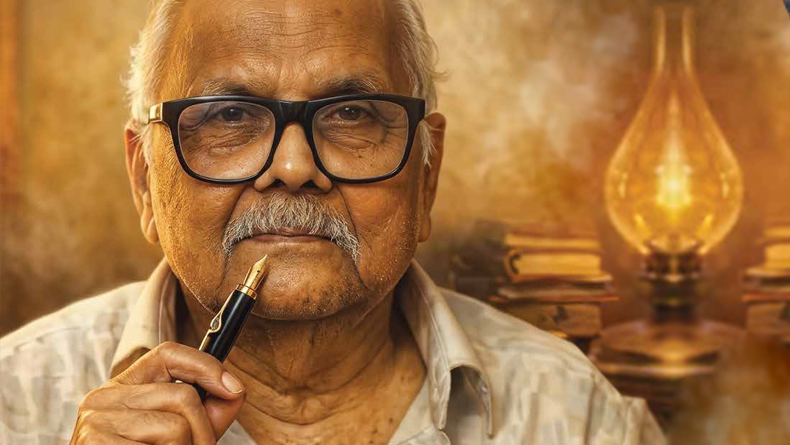
A Man Who Lived Like a Blazing Flame
Thottam Rajasekharan was an outstanding orator,a man of unwavering integrity who never bent his spine before authority, and a writer who waged an armed revolution through the sharpness of his language

Salin Mankuzhi
Former Additional Director, (I&PRD)
|
Thottam Rajasekharan Thottam Rajasekharan was born in Thiruvananthapuram in September 1930 to Advocate R. Kumaran and M. Gomathi of Veluthery House. After completing his Master’s degree from University College, he served as a lecturer at Mar Ivanios College for two years, worked as a journalist for one year, and served for three years as a Social Education Officer in the Development Department. From 1958 to 1985, he was associated with the Public Relations Department. He also served as Secretary of the Kumaran Asan Memorial Society, Member of the Board of Directors of the Film Development Corporation, Member of the Film Censor Board, and Public Relations Officer to the Governor, among several other positions. Works
|
When we say someone has become a memory, it usually means they have faded into oblivion. But when we say someone like Thottam Rajasekharan who has caused a stir in words, thoughts, actions, and writing has become a memory — this means his personality still ignites the active memory of Malayalis. That distinction has been indelibly inscribed in the cultural history of Kerala. Serving as an officer in the Public Relations Department from 1958 to 1985, Thottam Sir spent the last ten years as its Director. That remarkable phase of his official career remains a blazing chapter in Kerala’s history.
Before leaving to attend a journalists’ union conference in 1976, Chief Minister K. Karunakaran asked his close confidant Thottam Rajasekharan what new ideas he should present at the gathering.
The reply Thottam gave that day remains as fresh today as it was historic:
- Establish a Press Academy in Kochi for the study of journalism.
- Introduce a Government pension scheme for journalists.
When the Chief Minister announced these two initiatives, the thunderous applause that followed has, in many ways, never ceased. Even today, several states visit Kerala to study the model conceived through those ideas. It is this enduring legacy that keeps Thottam Rajasekharan alive in the future as well. Thottam firmly believed that modernisation meant renewing the system itself.
Even forty-one years after his retirement, the distinction and prestige associated with the title ‘Director of PRD’ continue to remain untarnished because of Thottam Rajasekharan’s brilliance and strength. During his days as an ordinary officer in the Public Relations Department, the half-door of his office opened one day to welcome an unexpected visitor-the Leader of the Opposition, K. Karunakaran, whose party then had only nine members in the Legislative Assembly. He sought a few facts and figures on the agricultural sector for a speech he was to deliver in the Assembly. The detailed note Thottam prepared and handed over the very next day marked the beginning of a long, enduring, and mutually enriching association between an administrator and a civil servant. For anyone researching Kerala’s political history, that partnership and those two personalities remain impossible to overlook.
Seven or eight months after Thottam Sir retired from service, he happened to meet Monu Nalapat, then Editor of Mathrubhumi. During the course of their friendly conversation, the editor asked him:
‘Why don’t you write your service story?’
Thottam Sir’s response to that suggestion eventually became Udyogaparvam, the service memoir that set the pages of Mathrubhumi Weekly ablaze for more than a year beginning in August 1986. Even today, Udyogaparvam stands tall as the pioneering and definitive work among service memoirs. Thottam Rajasekharan was renowned for his fearless candour. He was an outstanding orator, a man of unwavering integrity who never bent his spine before authority, and a writer who waged an armed revolution through the sharpness of his language.
His profound scholarship in the literature and philosophy of Sree Narayana Guru constituted the core of his intellectual strength. His final book, Vakko Thokko (Word or Gun), a collection of essays, was released in April 2026. I had the privilege of receiving the first copy on that occasion. Even in the brief address he delivered that day, his extraordinary memory and remarkable clarity of thought shone with the vitality of a man in his thirties. Anyone who knew Thottam Sir would readily agree that a young man continued to reside within the heart of that ninety-five-year-old.
Thottam Rajasekharan was a flame that appears only on the rarest of occasions. He devoted thirty-three years to public service, followed by more than four decades of an equally purposeful and productive life after retirement. He continued to write and speak until his very last days. It would be fitting to describe Thottam Rajasekharan’s life as an open book. But not in the ordinary sense of that expression. Rather, every page of that book forms an integral part of Kerala’s political, social, and literary history-pages that deserve to be opened, read, and studied