
Building a Global Maritime Hub
MISSION SAMUDRA

Dr. Jayakumar
Former MD and CEO, Vizhinjam International Seaport Limited.
Member-Kerala Maritime Board
Kerala today possesses a unique advantage with two international ports—the Vizhinjam deep-water multipurpose port and container transhipment terminal at Vallarpadam, Cochin—and a network of shallow, small and intermediate ports along its coastline. However, ports alone do not create prosperity and socio-economic growth in a region. Around the world, successful port regions such as Shanghai, Singapore, Rotterdam and Dubai have demonstrated that the real value of ports lies in the ecosystems they support, including logistics, manufacturing, tourism, trade, innovation and services.
Kerala needs a differentiated hierarchy — anchor ports of international significance, regional ports and coastal ports that form the connective tissue of an integrated maritime transport network.
The emergence of Vizhinjam Port presents Kerala with a historic opportunity. Combined with Cochin Port and the state’s wider maritime network, it can catalyse investments, create employment, strengthen global connectivity and support the growth of the blue economy.
To realise this potential, Kerala needs an integrated approach that connects port infrastructure with industrial development, tourism, transportation, fisheries, urban planning, environmental stewardship and skill development. A plausible approach would be to effectively integrate the entire maritime ecosystem into a coherent development strategy.

With the natural resources available and the immense maritime potential, Kerala can emerge as India’s leading port-driven economy while maintaining its commitment to sustainability and quality of life. In this context, it is vital to select ports based on their potential, the type of development envisaged, their feasibility and the manner in which coastal shipping, which plays an important role in Kerala, can be incorporated.
Instead of looking at Kerala as a coastal state with ports, it would be more appropriate to see it as a potential port-state economy. Kerala’s opportunity is different. It lies in corridor logic, given its proximity to the world’s busiest east-west shipping lane; ecosystem differentiation, with a biodiversity-rich coastline and an existing blue economy; and nodal completeness, by connecting a tiered port network with waterways, roads, rail and inland logistics.
In this context, a structured strategic framework for an integrated maritime hub in Kerala can be as follows:
Three-Tier Port Architecture
The fundamental design principle should be that each port in the state serves a distinct and complementary role. Rather than treating all ports as variations of the same facility, Kerala needs a differentiated hierarchy comprising anchor ports of international significance, regional ports serving specific industrial and geographic needs, and coastal port nodes that form the connective tissue of an integrated maritime transport network.
Tier 1: The Two Anchor (International) Ports
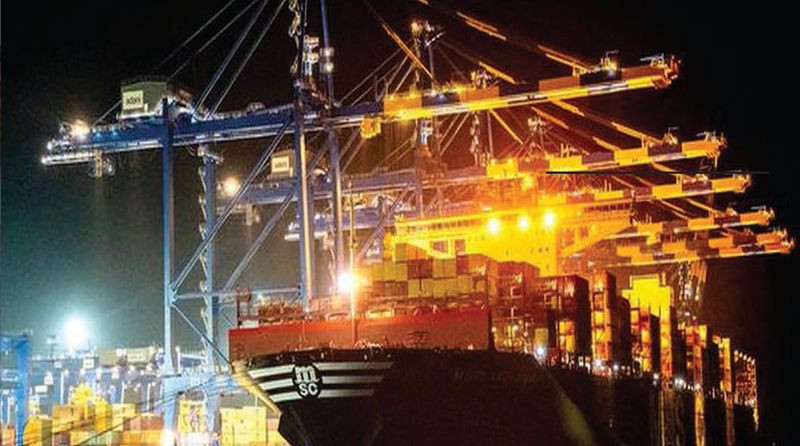
Vizhinjam’s singular advantage is geographic and geological. Located approximately 10 nautical miles from the main east-west international shipping lane, it possesses a natural draft of over 20 metres, which means ultra-large container vessels in the 18,000–24,000 TEU class can call without expensive and ecologically damaging continuous dredging. The port is being developed mainly as a container transhipment terminal, and this is the right primary function. However, the surrounding development ecosystem needs to be built in parallel to realise its full potential.
The emergence of Vizhinjam Port presents Kerala with a historic opportunity. Combined with Cochin Port and the state’s wider maritime network, it can catalyse investments, create employment, strengthen global connectivity, and support the growth of the blue economy.
Around Vizhinjam, priority developments should include a Free Trade and Warehousing Zone and a Multi-Modal Logistics Park to attract value-added logistics, a ship-repair and green-bunkering cluster, besides the outer-area growth corridor and related project on the anvil.
Kochi’s development story is already well established, with its multipurpose cargo port, international container terminal at Vallarpadam, Cochin Shipyard and emerging cosmopolitan knowledge economy. The strategic direction for Kochi should be to become a maritime knowledge-economy hub—a city whose prosperity derives not only from physical cargo movement but also from ship design, shipbuilding, cruise tourism and maritime services.
Tier 2: Regional Ports
Beypore in Kozhikode requires careful thinking because the temptation will be to transform it into a modern container terminal. Shallow water depths and dredging constraints limit its scalability for deep-draft vessels. However, Beypore’s true strategic value lies in two important areas: its dhow-building heritage, particularly the construction of traditional wooden vessels, and its role as a regional cargo hub for northern Kerala. Construction materials, consumer goods and agricultural inputs for the Malabar region should move through Beypore rather than by road wherever economically and operationally feasible. A heritage maritime cultural zone built around the traditional shipbuilding yards, combined with a maritime museum, fishing-harbour modernisation and a tourism economy, would create something genuinely distinctive.
Azhikkal in Kannur plays an entirely different role. It can serve as the industrial entry point for the Kannur-Kasaragod corridor. Fertilisers, petrochemicals, minerals and construction aggregates currently move by road from the south and north, adding both cost and congestion. The depth available at Azhikkal riverine port is not sufficient for large bulk carriers, but medium-sized vessels and barges are feasible. Developing Azhikkal as a dedicated multipurpose port, along with an SEZ and emerging industrial estates in this corridor, would meaningfully reduce logistics costs for northern Kerala’s manufacturing and agricultural sectors. Developing an outer harbour to serve as the maritime gateway to the Malabar region should therefore receive high priority.

Thankasseri Port in Kollam functions as an all-weather lighterage port that blends historical maritime significance with modernised coastal infrastructure. Maintaining an operational water depth of 6.5 metres, the port allows direct berthing access for medium-sized cargo vessels. Neendakara Port in Kollam is a major fishing harbour and lies very close to Thankasseri Port. A dedicated fisheries and seafood-processing SEZ at Neendakara, built around the existing fishing harbour and supported by cold-chain infrastructure, could transform the economics of Kerala’s fishing communities and create substantial export value.
Tier 3: Coastal (Ports) Nodes
Alappuzha, Ponnani and Kasaragod minor ports may be developed with minimum infrastructure facilities to facilitate coastal shipping activities in Kerala. The objective should not be to replicate the facilities of the major ports but to create a distributed network of cargo collection, consolidation and transfer points. Alappuzha Port has an additional opportunity for the development of a marina because of its strategic location on the coast, its existing backwater network and its strong tourism base. It can anchor Kerala’s coastal tourism circuit by offering safe berthing, maintenance and hospitality services for leisure craft and cruise yachts.
A Novel Concept in Coastal Shipping
An innovative concept employing Green Small Container (GSC) units can further augment coastal shipping and revitalise the minor ports. More than a container, the GSC represents an integrated logistics ecosystem designed to connect the hinterland directly to coastal shipping networks through modular containerisation, shallow-port operations and smart logistics management.

Each container would have approximate dimensions of 6.5 feet by 8.0 feet by 8.5 feet. These containers would allow transportation through narrow roads, village routes, plantation regions, hilly terrains and urban environments using light commercial vehicles. Unlike conventional 20-foot containers, GSC units can be independently transported, loaded and unloaded close to the cargo source.
Three GSC units can be securely interconnected to form a composite cargo unit having dimensions equivalent to a conventional 20-foot rectangular container or TEU, making it compatible with gantry cranes at deep-water ports and conventional container vessels.
Cargo can be moved through small trucks and light commercial vehicles by road and by small vessels or barges through rivers and inland waterways to shallow ports. The shallow ports would function as cargo-consolidation centres from where the GSC units could be loaded onto barges or shallow-draft vessels and integrated with the main coastal shipping network at the deep-water anchorages of major ports.
Institutional Governance
Public-Private Partnership model offers an effective path for Kerala’s maritime sector because it combines the state’s land, policy support and oversight with private investment and global operational expertise to build and operate a globally competitive maritime hub. At the same time, this approach must be pursued with strict environmental safeguards, including impact assessments, continuous monitoring and site-specific mitigation measures to protect coastal ecosystems and fishing livelihoods during project implementation.