

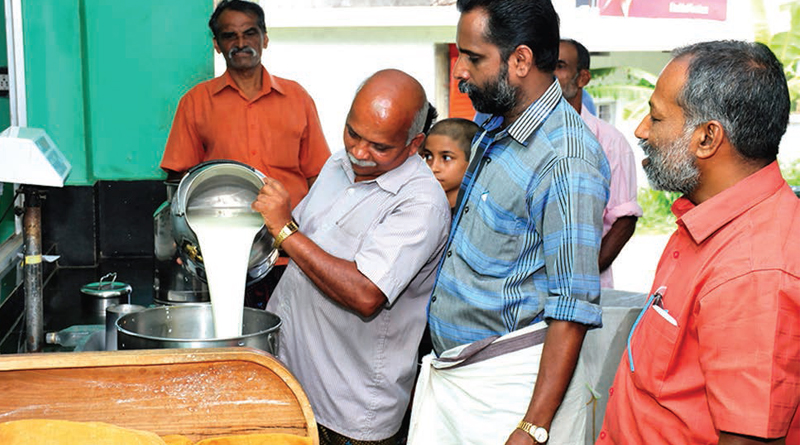
On the Path to Self-reliant Dairy Dreams
“In the past decade, animal husbandry and dairy development has become vital to the people’s daily life, which is the real administrative success. Programmes and specific schemes for women, young entrepreneurs, NRIs and housewives are being implemented. The government is making comprehensive interventions to raise the standard of living for dairy farmers, ensuring sustainable growth for all.”
-J. Chinchurani
Minister for Animal Husbandry & Dairy Development
 Kerala’s dairy industry has become a pillar of sustainable agricultural growth, blending scientific progress with community participation to create a model of resilience and self-reliance. With consistent investment, innovative practices, and strong support from local bodies, the state has transformed milk production into not just an agricultural success story, but a driver of rural prosperity and economic empowerment. The state boasts over 94 percent crossbred cows, with an average daily milk production of 10.79 kg. Nationally, the state ranks second in this. At present, Kerala produces eighty percent of milk domestically, which is an achievement unparalleled by any other agricultural product. In the last ten years, development activities totalling Rs 922.51-crore from the state budget were implemented in the state. It has to be noted that the allocation in the last ten years helped in introducing 44,369 milch cows and 10,906 heifers to the state. In 2024-25, local bodies saw a historic high in project spending in the dairy sector, exceeding Rs 143-crore, ensuring significant rural economic growth.
The Dairy Development Department offers a wide range of assistance to farmers to buy milch cows. Under the MSDP scheme, cow units get 15 to 45 percent subsidies each. For the youth, Smart Dairy Farm projects are implemented and the Ksheerasree portal gives a speedy disbursal of the applications. The Ksheeragramam programme has been introduced on an industrial basis in selected panchayats. Apart from this, the government also extensively supports fishermen and plantation workers through Ksheeratheeram and Ksheeralayam initiatives. Various initiatives such as goat farming and satellite units for women are being implemented with the cooperation of KLD Board in villages.
The government also promotes large goat and pig farms through National Livestock Mission funds. The government also provided crores of rupees as relief for the loss suffered by farmers due to avian flu, African swine fever, lightning and snake-bites. The state also covers interest of loan on farm operation and renovation for five years. The farmers also got much relief by increasing the fodder and feed subsidies. Lakhs of chicks were distributed through KEPCO in the last five years. Moreover, the price of feed was controlled and special feeds like ‘Mahima’ were introduced. Improving cattle genetics to raise milk yields remains a long-term vision, with highquality bull semen, sex sorted insemination, model incubation centres and research hubs leading this progress. Effective steps were taken to control stray dogs and zoonotic diseases, as the government leads in making the ‘One Health Mission’ a reality. Services in the sector have truly advanced in many ways. Thiruvananthapuram’s multispecialty hospital, ‘e-Samrudha’ digital tools, the 1962 helpline, mobile veterinary units and night-time treatment facilities have facilitated healthcare for farmers’ livestock.
Key Achievements
• Daily milk collection through cooperatives rose from 16.27 lakh litres in 2016-17 to 19 lakh litres. This is nearly double the national average.
• To manage surplus milk, a new factory with a 10-metric-ton capacity for milk powder production was established at Moorkkanad in Malappuram.
• A dedicated project providing one cow unit each to 278 selected extremely poor families was implemented to improve their livelihoods.
• As part of bringing services directly to farmers’ doorsteps, mobile veterinary units were established in 76 blocks, alongside 12 mobile surgery units
• A centralised 1962 call centre system was implemented for quick response.
• The use of sex-sorted semen, which ensures 90% accuracy in producing only female calves, was made accessible to local dairy farmers.
• In the government sector, high-tech goat breeding centres were established in Bandaduka, Kasaragod, and a Centre of Excellence in Parassala, Thiruvananthapuram
• In collaboration with local self-government departments, 20 ABC centres and one portable centre are operational for rabies vaccination and stray dog sterilisation.
• The Gosamrudhi cattle insurance scheme provides coverage for animal death and loss of productivity at the lowest possible premium rates.
• The compensation for livestock losses from the Disaster Management Fund have been increased. An amount of Rs 12.86-crore for bird flu, Rs 6.72-crore for African swine fever and Rs 1.2-crore for lumpy skin disease has been provided.
• Kerala Veterinary & Animal Sciences University developed new hybrid chicken named ‘Triveni’ and ‘Chaitra’ ducks. Additionally, Kuttanadan ducks have received breed registration
• In Kuttanad, elevated community cattle shed projects were launched around the Champakkulam and Chempumpuram dairy cooperative societies.
• Domestic egg production has significantly increased across the state through various schemes by KEPCO.
• Kerala Feeds Limited ensures cattle feed availability through approximately 1,500 cooperatives and 600 private dealers in the market.
• Meat Products of India opened a 15-crore modern value-added processing plant in Kollam. Modern franchise outlets named MPI Meat & Bite’ were launched to strengthen retail marketing.
• The interest subvention scheme that covers the full interest on bank loans was introduced.
• Contingency financial aid for uninsured cattle was raised from Rs 12,000 to RS 15,000, benefiting over 6,000 farmers state-wide.
• A diagnostic facility with international standards was set up at State Institute for Animal Diseases (SIAD) Palode, State Laboratory for Livestock, Marine & Agri Products (SLMAP), Avian Disease Diagnostic Lab and Palakkad regional Disease Diagnostic centre.
• The Kerala Livestock Development Board established Regional Livestock Fertility Management Centres at Chithara in Kollam and Thalayolaparambu in Kottayam to boost productivity.
• An ultra-modern laboratory was established in Velinalloor, Kollam, for advanced animal disease diagnosis with support from the Rajiv Gandhi Centre for Biotechnology.