

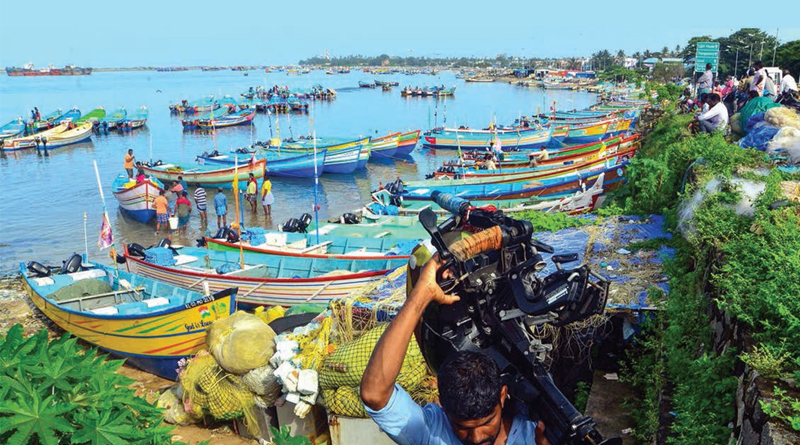
The Horizon Beckons
“It is the declared goal of our government to hold close to its heart the’army’ that has become Kerala’s steadfast guardian during floods and the pandemic. We have ushered in revolutionary changes in the fisheries sector across housing, education, security and modern technology. In 2024, Kerala earned national acclaim as the country’s best maritime state—a fitting recognition of these transformative efforts. Along with preserving the uniqueness and cultural heritage of Kerala, the Department of Culture has given priority to the welfare of artists and the propagation of renaissance values.”
-Saji Cherian
Minister for Fisheries and Cultural Affairs
 Kerala has long been defined by its intimate relationship with the sea—its coastline shaping livelihoods, culture, and communities. Yet, this proximity also brings vulnerability, as thousands of families face the constant threat of sea waves and coastal erosion. In response, the Government of Kerala has launched various projects in the past decade.
Residential Security
The ‘Punargeham’ project, which relocates coastal residents living under the threat of sea waves to safer areas, is a major step in the development history of Kerala. So far, 9,108 families have expressed their willingness to participate in this massive project, which aims to resettle 22,174 families. We have already rehabilitated 3,498 people by constructing 2,760 individual houses and 738 flats. The construction of 788 flats and 1,186 houses is progressing at a rapid pace. 332 homes were built in the Pratyasha flat complex in Muttathara at a cost of Rs 81 crores for fishermen who were staying in a cement godown. We were also able to provide houses to 16,798 fishermen through the LIFE project.
Empowerment through Knowledge
The Vidyatheeram project has enabled the new generation of fishermen families to reach the top of the world. As a result of providing financial assistance of up to Rs 1.25-lakh for medical/ engineering entrance training, 55 students have been admitted to MBBS and 72 to professional courses including BDS and BTech since 2021. Moreover, 45 orphans were assisted through the adoption scheme, which provides up to Rs. 1 lakh for them. Along with providing facilities for children of fishermen to study in foreign universities, ten fisheries technical schools were upgraded to Centres of Excellence at a cost of Rs. 52-crore. Counselling facilities were created and counsellors were appointed to improve the stress management of students and the quality of education of students.
Increased Fish production
Marine fisheries production increased from 4.83 lakhs metric tonnes in 2017-18 to 6.47 lakhs metric tonnes in 2024-25. Production was increased to 41,175 tonnes through mass fish farming. To increase the fish resources in the sea, 6,300 artificial reefs were installed at a cost of Rs. 13.02-crore on the coasts of 33 fishing villages in Thiruvananthapuram district.
Modern Technology
Modernisation was the need of the hour. Hence, 10 boats worth Rs. 1.50-crore were provided to fishermen groups for deep sea fishing at a subsidised rate. A project to distribute 12,991 transponders at a cost of Rs. 47.28 crores for the safety of vessels is in progress. Traditional wooden boats were upgraded to steel vessels with a budget allocation of Rs. 10-crore and VHF marine radios were installed in 836 vessels. In addition to this, 57 fish markets were renovated at a cost of Rs. 142 crores to ensure unadulterated fish to the consumers. Modern markets are being set up at a cost of Rs. 100-crore in Aluva and Kozhikode.
Harbour Development
The department focused on harbour development as well. As a result, 2,061 coastal roads were completed at a cost of Rs. 1,142.43-crore. For the expansion of Muthalappozhy harbour Rs. 177-crore was allocated and Rs. 271-crore for a new harbour at Vizhinjam. Administrative sanction of Rs. 5-crore was given for the construction of a harbour at Pozhiyur. Ports at Manjeswaram, Koyilandy, Tanur and Vellayil were dedicated to the nation. India’s first offshore breakwater coastal protection project using geo tubes was completed at Poonthura.
Welfare Schemes
Insurance cover totalling Rs. 20-lakhs has been provided to fishermen including Rs 10-lakhs insurance of the Fisheries Board and Rs. 10-lakhs to Matsyafed members. Retirement benefit has been granted for the first time in history and Rs. 2-crore has been set aside for this purpose. Rs. 184.82-crore has been provided as financial assistance to those who lose their jobs due to weather warnings during this government’s tenure alone. Free travel has been ensured to women marketers through Samudra Bus service. 607 units have been started through SAF and the turnover has reached Rs. 150-crore. In addition, project proposals worth Rs. 7,288-crore have been received through the ‘Blue Tides 2025’ conclave.
• Under Suchitwa Sagaram Sundara Theeram project, 1,54,316 kg of plastic waste removed.
• The loss-making Matsyafed brought into profit.
• A project to convert marine plywood boats into fibreglass boats implemented.
• Aquatourism projects developed in Matsyafed farms.
• Kerala Seafood Cafe started in Vizhinjam. Cafes to be opened across Kerala.
• Online sales of Matsyafed value-added products started through the K-Shoppe system.
• Twine factory has started operations in Alappuzha.
Department of Culture Culture is the heartbeat of Kerala, and preserving spaces for artistic expression has always been central to the state’s identity. Recognising the need to nurture creativity even in areas where public venues are scarce, Kerala has introduced innovative initiatives such as Nattarangu— roadside stages that bring performances directly to the people. With completed stages in Vallikkunnu, Chengannur, and Alangad, and more under construction, these platforms symbolise accessibility and inclusivity in the arts. Alongside this, the state is investing in long-term cultural infrastructure: a shelter home for veteran artists in Mavelikkara, a new headquarters for the Cultural Department in Thiruvananthapuram, and the ambitious South Indian Cultural Centre in Kannur, envisioned as Kerala’s future cultural hub. A KIIFB supported project to construct cultural complexes in the names of renaissance leaders in 14 districts are in the pipeline; three projects are completed, out of which two were commissioned in Kollam and Palakkad; the third project in Kasaragod is ready to inaugurate.
 Support for artists
A special project was envisaged to help artists tackle crisis during Covid. Special projects are also implemented to encourage tribal arts, coastal arts and artists with disabilities. The ‘Samam’ project launched to ensure gender equality and Swatantra Smriti Park, set up in Chengannur in memory of the freedom fighters are part of the cultural awareness campaign. The centenary celebrations of Vaikom Satyagraha and Aluva All Religious Conference were organised in a grand manner. 758 rural artists were employed through the Rural Art Hub, implemented through “Vastuvidya Gurukulam”. In addition, 423 new artist pensions were granted from 2021 to 2025 and more than Rs 30-lakh was distributed as medical assistance.
Film Sector
The first government-owned OTT platform ‘C-Space’ was launched in India. Several films were released under the scheme of providing financial assistance of Rs 1.5-crore each to women and SC/ST category filmmakers. Chitranjali Studio is being modernised with KIIFB funding of Rs 150-crore. Notable achievements include increasing pension amount through Kerala Chalachitra Academy, conducting 2G restoration of old films, and organising film camps for tribal children.
Academies
The admission of girls to study Kathakali in the Kerala Kalamandalam and the steps taken to transform it into a full-fledged university are historic decisions. The first International Literature Festival was organised under the leadership of the Sahitya Akademi. The ‘Kerala Artist Data Bank’ was prepared for the first time in India through the Sangeetha Nataka Akademi. The number of learners through the Malayalam Mission was increased to 76,259. The ‘Ananya Malayalam’ project was started for guest workers. The ‘Bala Keralam’ project of the Vailoppilly Samskriti Bhavan was used to develop rationality in children, and 268 new books were published through the Bala Sahitya Institute.
• Diamond Jubilee Fellowships for 1000 artists to encourage young artists and enable local cultural development
• Diamond Jubilee Fellowship amount increased to Rs. 17,500
• New posts created at the district and state levels to coordinate the Fellowship project
• Artist Pension for deserving artists above 50 years of age.
• Kollam Art Gallery to preserve and exhibit the priceless paintings of world-renowned painter A. Ramachandran.
• Vocational training project to increase the presence of women in the technical field of cinema
• Cafe Bookmark launched in Thiruvananthapuram in the field of book publishing