

Bringing Up Differently
MYNA UMAIBAN
Kerala’s BUDS schools empower differently-abled children and their families through inclusive education, community support and a transformative vision
In the quiet corners of Kerala, an unheralded revolution is reshaping the meaning of inclusion. Hope now speaks aloud—in the laughter of children once sidelined, in the newfound strength of mothers, and in classrooms that welcome every child, regardless of ability. At the heart of this movement lies BUDS— Bringing Up Differently-abled Souls—a community-led Kudumbashree initiative to transforming and redefining the very soul of social care and education in Kerala; a vision of inclusive India breathes life.
In many traditional households, the birth of a differently-abled child shifted the future silently— especially for mothers that they became full-time caregivers, sacrificing their careers, personal ambitions, and social interactions. The emotional toll was heavy, the f inancial strain real, and yet the burden remained largely invisible to society.
Sheela, a mother from Thrissur, recalls: “I spent years confined within four walls, solely caring for my son. After enrolling him at BUDS, I began tailoring work. Now, I earn, he learns”.
Zuhara shares a similar journey. Once tethered by care giving, she joined a Kudumbashree micro-enterprise when her daughter started at a BUDS school. “I never imagined having my own income. Today, I am not only a mother—I’m a business woman”. These voices are not solitary—they echo across thousands of homes In Kerala.
Kerala’s flagship mission for poverty alleviation and women’s empowerment, BUDS represents a bold step forward: What if differently-abled children could be equipped with skills to lead independent, dignified lives
Thus emerged BUDS Schools and Rehabilitation Centres—run by local self-governments with Kudumbashree’s support. More than mere institutions, they are sanctuaries of learning, healing, and social reintegration.
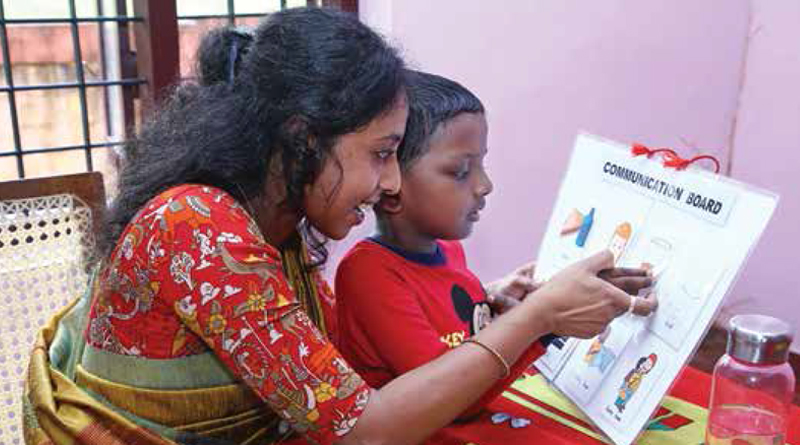
At BUDS schools, children aged 5 to 18 receive specialized education in life skills, emotional development, communication, and creativity. For many, this marks their first venture beyond home—a step into a world that embraces their presence and potential.
For individuals above 18, BUDS Rehabilitation Centres (BRCs) offer vocational training in tailoring, craftwork, food processing, and more—turning dependence into self-worth.
Take Adil, 16, who has Down syndrome. Once non-verbal, he now speaks and confidently participates in school events. Or Jasla, trained at a BRC, who now operates a tailoring unit and supports her family. “Before BUDS, we felt alone. Now, my child has friends, he learns, and above all – he is happy.” Latha, a mother, sums it up poignantly.
What distinguishes BUDS is its deeply community-driven approach. Parents, panchayats, and Kudumbashree work hand in hand to craft nurturing environments that reject exclusion and embrace diversity. “This isn’t just about classrooms,” says a Kudumbashree official. “It’s about changing societal perceptions and affirming every child’s right to dream.”
Every August 16, Kerala celebrates BUDS Day, marking the inception of the first BUDS school in 2004 at Venganur—a pioneering collaboration between Kudumbashree and the local GramaPanchayat. Since then, the network has grown exponentially, touching thousands of lives.
Beyond academics, BUDS institutions honour ability through the BUDS Olympia—a vibrant sports and cultural festival where differently-abled children showcase their talent. Here, the true victory lies not in medals but in confidence, joy, and participation.
Crucially, BUDS also invests in those who care for these children. Teachers and caregivers (ayahs) are trained in innovative, neuro diverse pedagogy. Parents receive counselling, awareness training, and skill-building programs—empowering them as active partners in their child’s journey. Children benefit from therapies that build emotional strength, social skills, and a sense of belonging.
This holistic ecosystem ensures that no child is merely enrolled—they are seen, heard, and celebrated. Challenges remain. In remote pockets, awareness is still scarce, and stigma persists. Yet, each success story adds momentum to the movement.
On June 2, all 378 BUDS institutions in Kerala hosted an admission festival, welcoming 13,081 new beneficiaries. With the participation of ministers, MLAs, and local communities, the event wasn’t merely ceremonial—it signified a societal shift toward visibility, dignity, and shared responsibility. Gifts of umbrellas, learning kits, and school bags symbolized solidarity and care.
In a world that too often sidelines its most vulnerable, Kerala’s BUDS initiative stands as a luminous example of what compassionate governance, community participation, and unwavering vision can achieve. More than institutions, BUDS schools are beacons— illuminating paths for children who once dwelled in the shadows, and for mothers who dared to dream again. This is not merely Kerala’s success; it is an invitation to the world: to build societies where no life is overlooked, and every soul is nurtured to shine.
The writer is the author of many collection of short stories, novels and essays and a recipient of Kerala State Institute for Children’s Literature Award.