

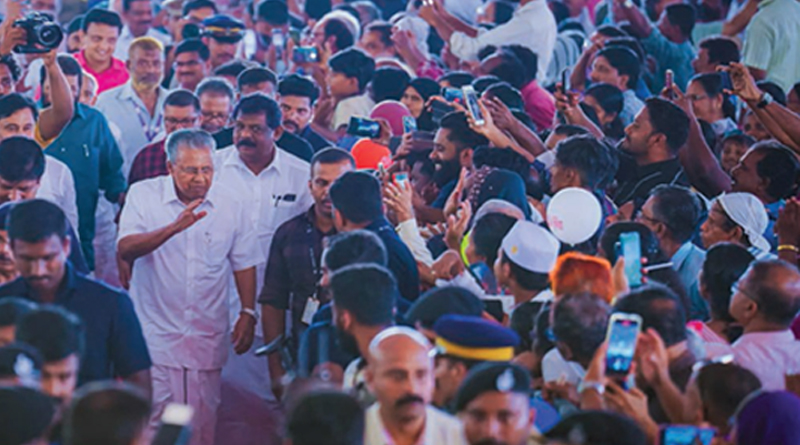
Building Kerala’s Legacy
The Vision 2031 international conference was an exercise that tried to understand Kerala’s past, critically assess its present and constructively think about its future. Kerala’s development journey has never been a straight line. From land reforms and investments in public education and health, to social security and decentralised planning, the so-called ‘Kerala’s development experience’ has been one of continuous renewal.
The political roots of decentralisation in Kerala can be traced back to the first Communist ministry under E. M. S. Namboodiripad, which recognised local democracy as essential to social transformation. Decentralisation in Kerala has matured over time. The Urban Policy document proposes the constitution of a committee to recommend amendments to the Municipal Act. Similarly, the Vision 2031 document prepared by the LSGD calls for comprehensive reforms to the Kerala Panchayati Raj Act. These initiatives reflect our commitment to ensure that decentralisation remains relevant, effective, and democratic in a rapidly changing economy.
 We have pioneered a new democratic model by publishing an annual progress report that appraises citizens on the extent to which we have implemented the promises made in our manifesto—a record of sorts in the history of Indian democracy. This government has also gone the extra mile to understand people’s feedback on governance. For the first time in Kerala’s history, the entire cabinet traveled to all assembly constituencies, heard what people had to say, listened to their problems, and found time to resolve them.
We have demonstrated that determination and dedication can lead to extraordinary results. It is a matter of immense pride that Kerala has witnessed a transformation in infrastructure development and economic growth over the last decade. Several previously stalled mega projects—such as the GAIL pipeline, National Highway expansion, Kochi-Edamon power corridor, and Puthuvypin LPG terminal—were revived and successfully completed. India’s first trans-shipment terminal, Vizhinjam International Seaport, has already welcomed some of the world’s largest ships, even before reaching full operational capacity. Now we are addressing another long-standing demand: the Angamaly-Sabari railway project, for which the government has sanctioned ₹1,900 crore, including land acquisition costs. The government is committed to facilitating high-speed rail travel from Thiruvananthapuram to Kasaragod. The Regional Rapid Transit System, covering 583 km at an estimated cost of ₹1.92 lakh crore, will hopefully improve our connectivity. KIIFB has fulfilled many of Kerala’s needs, evident in state-wide advancements in education, health, national highway development, coastal-highland highways and other infrastructure.
The achievements Kerala has made in health and education over the past ten years are astonishing. Public health facilities have become more patient-friendly, with even advanced surgeries like heart transplants now performed in government hospitals. The recently inaugurated Cochin Cancer Research Centre (CCRC) will become a hub for cancer treatment.
Our educational institutions have been elevated to international standards. World-class labs and smart classrooms are no longer alien to the children of ordinary people. With the aim of transforming Kerala into a global knowledge society, the state government is reforming the higher education sector, providing international-standard study facilities, and fostering research aptitude among students.
Social welfare schemes have been implemented effectively. Increasing social security pensions to ₹2,000 is proof of this government’s care for the needy; today, pensions reach around 64 lakh people. In addition, the revolutionary decision to provide pensions for housewives without other sources of income, along with increased honorariums for scheme workers including ASHA workers, marks a major milestone in women’s empowerment.
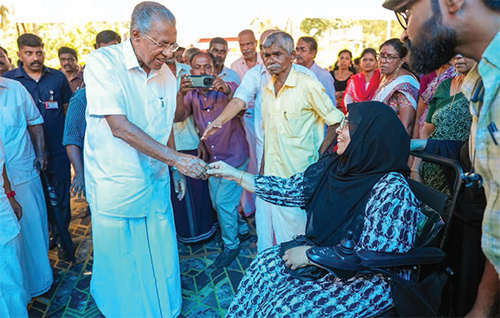 Kerala’s greatest achievement is attaining the status of an extreme poverty-free state. We have identified families pushed to the margins of society—those unable even to raise their voices—and brought them back into the mainstream of life.
We are realising the goal of a house for everyone through the LIFE Mission. So far, around 4.71 lakh families have received completed houses. By distributing 4,10,956 land titles, Kerala has rewritten the social dynamics of the state.
Crises have been managed efficiently, restoring public confidence. The model township for survivors of the Mundakkai-Chooralmala landslides is getting ready. Through the Chief Minister’s Distress Relief Fund, we have disbursed ₹8,285 crore over the last ten years, including ₹1,836 crore in medical assistance to needy persons. In the last decade, Kerala has stood as a state free from communal clashes.
While protecting traditional industries, Kerala is transforming into a hub for knowledge-based industries. ‘Investment-Friendly Kerala’ is not just a slogan but a practical reality. Kerala’s progress in the Ease of Doing Business ranking is a model for the entire country.
As we look ahead, the Kerala Model stands as a beacon of progress, blending social justice with economic vitality. It is worth reflecting on what Kerala’s experience offers to the wider world. It demonstrates that decentralisation can strengthen, rather than fragment, the state. The Kerala of 2031 must be prosperous, innovative, and resilient. But above all, it must remain democratic and secular in spirit.
1. Infrastructure & Transport
Kochi Metro Rail Limited (KMRL)
• Phase I Execution: The first major phase of the Kochi Metro, spanning 25.2 km from Aluva to Petta, was successfully commissioned in stages between 2017 and 2020.
• Infrastructure: This phase included the construction of 22 stations.
• Investment: The project was executed at a total cost of ₹ 2,618 crore, establishing a modern urban transport backbone for the city.Inland Navigation (Coastal Waterways)
• Policy Formulation: In 2016, the government made the in-principle decision to develop the 616 km West Coast Canal (Kovalam to Bekal) into a fully navigable waterway.
• Land Recovery & Rehabilitation: Initiated the complex process of rehabilitating families encroaching on the waterways. Specifically, 1,300 families were identified for rehabilitation to recover land for the Kovalam– Varkala stretch.
Kerala Shipping and Inland Navigation Corporation (KSINC)
• Fleet Expansion: Significant government plan funds were utilized to construct and commission new vessels:
o 2017–18: Commissioned Orion, a 500-ton bulk barge.
o 2018–19: Commissioned Nefertiti, a premium 200-passenger cruise vessel.
o 2018–19: Commissioned Cleopatra, a 100-passenger fast ferry boat.
o 2019–20: Commissioned Michelle, a 100-passenger fast ferry boat.
2. IT & Electronics Ecosystem
• Technopark Status (2016 Baseline): The park hosted 370 companies with a total built-up area of 8.51 million sq. ft., employing 51,860 people.
• Startup Ecosystem: In 2016, the state had approximately 300 startups.
• Centres of Excellence: The IIOT Sensors Centre of Excellence was established at Maker Village, Kochi, in 2016.
3. Environment & Coastal Regulation
• Regulatory Establishment: The Kerala Coastal Zone Management Authority (KCZMA) officially commenced functioning under the State Environment Department on April 1, 2017.
• Coastal Planning (CZMP 2011): The Coastal Zone Management Plan (CZMP) compliant with the 2011 notification was prepared and received approval from the Ministry of Environment, Forest and Climate Change (MoEF&CC) on February 28, 2019.
• Biodiversity Initiatives:
o Kerala became the first state to constitute Biodiversity Management Committees (BMCs) in all Local Self Government Institutions.
o The Asramam mangrove area in Kollam was declared the state’s first Biodiversity Heritage Site (BHS) in 2019.
 4. Aviation & Ex-Servicemen Welfare
• Aviation Training (RAGAAT): The Rajiv Gandhi Academy for Aviation Technology began offering simulator training to external candidates in 2020, optimising resource utilisation.
• Ex-Servicemen (KEXCON):
o Employment Base: As of March 2016, the corporation provided employment to 2,709 ex-servicemen.
o Financials: The capital turnover stood at approximately ₹ 12 crore in March 2016.
1. Mega Infrastructure Projects
Kochi Metro Rail Limited (KMRL)
• Phase I A Completion: The 1.8 km stretch from Petta to SN Junction was inaugurated in September 2022. This included two new stations (Vadakkekotta and SN Junction) at a cost of ₹710 crore.
• Phase IB Completion: The 1.2 km stretch from SN Junction to Thripunithura Terminal was inaugurated in March 2024, marking the completion of the first metro corridor into the royal town.
• Financial Turnaround: KMRL achieved an operating profit of ₹ 33.35 crore
in FY 2024–25, marking two consecutive years of operational profitability.
• Phase II Progress: Land acquisition is 100% complete for the Pink Line (JLN Stadium to Kakkanad), and civil works have been awarded.
Kochi Water Metro
• Inauguration: Inaugurated on April 25, 2023.
• Current Operations: Operates 20 electric-hybrid boats across 6 routes, connecting 12 terminals and covering 26 route kilometers.
• Ridership: Recorded a cumulative ridership of 5.2 million passengers.
• Recognition: Received the Gussies Electric Boat Award 2022 and was designated a model project under the Government of India’s Harit Nauka Guidelines 2024.
Railways
• VandeBharat: Successful introduction of Thiruvananthapuram–Kasaragod and Thiruvananthapuram–Mangaluru Vande Bharat trains.
• Infrastructure:
o Administrative sanction received for the Nemom Terminal (₹116 crore).
o Balaramapuram–Vizhinjam tunnel line approved.
o Doubling of the Haripad–Ambalapuzha line completed.
2. Inland Navigation & Waterways
• Navigability Achievements: A total of 305.54 km of waterways were made navigable between Kovalam and Bekal.
• Tunnel Renovation: Specifically removed silt and debris to renovate the historic Chilakoor (330m) and Sivagiri (700m) tunnels in Varkala.
• Bridge Construction: Completed major structures including the Veliyamcode Lock-cum-Bridge, Muzhikkal Lock-cum-Bridge, Karikkakam Steel Lifting Bridge and Kallupalam.
• Terminals: Constructed approximately 50 boat jetties/terminals, including those at Muzhappilangad, Parassinikadavu and Kottappuram.
3. Public Sector Financial Turnaround
Kerala Shipping and Inland Navigation Corporation (KSINC)
• Profitability: Turned profitable in FY 2022–23 (Net Profit: ₹1.5 Cr) and increased profits to ₹87.98 lakhs (unaudited) in FY 2024–25.
• New Vessels:
o Sooryamshu (2022-23): Solar hybrid tourist boat.
o Poseidon & Lekshmy (2023-24):New additions to the fleet.
• Digitalisation: Launched www.mycruise.kerala.gov.in in 2024 for online booking of tourism vessels.
KEXCON (Ex-Servicemen Corporation)
• Financial Growth: Capital turnover skyrocketed to ₹119 crore by March 31, 2025.
• Employment: Employment provided to ex-servicemen nearly doubled to 4,460
(up from 2,709 in 2016).
• New Ventures: Launched KEXCON-NEETI Medicals (4 locations) and Self- Help Stitching Units for widows (4 locations).
4. IT, Science & Connectivity
KFON (Kerala Fibre Optic Network)
• Licensing: Secured IP1 certification (2022) and ISP ‘A’ License (July 2025).
• Reach: Provided connectivity to 23,163 government offices and 86,000 households (including 14,592 economically backward families in tribal areas like Attappadi).
IT Sector Growth (2025 Status)
• Technopark: Grown to 500 companies and 80,000 employees with 12.72 million sq. ft. of space.
• Infopark: Achieved software exports of ₹12,060 crore.
• Cyberpark Kozhikode: Exports surged to ₹130 crore (4,277% growth).
• Startups: The state now hosts 7,333 startups, providing 74,000 jobs.
Science & Technology (KSCSTE)
• Srinivasa Ramanujan Institute (SRIBS): Permanent campus inaugurated on
October 28, 2024.
• Supercomputing:Administrative sanction received for the K-STAR
Project (₹10 crore) in July 2025.
• One Health: Established the Centre for One Health at the Institute of Advanced Virology (IAV).
• Mathematics: Kerala School of Mathematics elevated to an autonomous Centre of Excellence in April 2025.
5. Environment & Water Security
• CZMP 2019: The revised Coastal Zone Management Plan (CZMP) based on the 2019 notification was approved by the Central Government on October 16, 2024.
• Legal Victories:
o Chempakavalli Dam: Secured dismissal of a petition in the Madras High Court (Sept 2022), protecting state interests.
o Parambikulam Aliyar: Secured full water share of 12.3 TMC during the severe drought of 2023–24 through effective monitoring and intervention.
Startup
* Country’s best performer in startup sector: 7400 startups, 74,000 jobs
* Financial support of Rs. 514 crore provided to startups through Kerala Startup Mission
* 63 incubators and 557 mini incubators established
* World’s first Super Fab Lab established in Kochi
* Historic breakthrough in IT exports
* IT exports of Rs. 90,000 crore (2016-24)
Expedited Wayanad Rehabilitation
* Township being built for disaster victims; Model house comes up in Kalpetta
* 1000 sq ft house in seven cents; total 451 houses
* Compensation for traders who lost shops and businesses in the disaster
* Registration department will provide free copies to those who have lost their land records.
KIIFB’s Quarter Century
* Driving force of infrastructure development
* 1190 projects worth Rs 90,562 crore
* Roads, bridges, flyovers and tunnels worth Rs 39,691.87 crore
* Industrial parks worth Rs 16,527 crore
* Transgrid 2.0 approved at Rs 5200 crore
* Projects worth Rs 6,874 crore for public health
Once Written Off; Now Standing Tall
* Vizhinjam port made a reality, further development will be completed by 2028
* GAIL pipeline completed
* Edamon-Kochi 400 kV line completed
* Puthuvype LPG terminal completed
* Kannur airport
EXCELLENT LAW ENFORCEMENT
From solving complex serial murders to dismantling organ and cybercrime networks, the Kerala Police has established itself as one of India’s most professional and technologically advanced law enforcement agencies. Their record since 2016 demonstrates not only crime detection excellence but also compassion and innovation. From handling mega religious festivals, cultural events, and elections, to containing civil unrest, Kerala Police has consistently ensured public safety, orderly conduct of democratic processes, and protection of constitutional rights. Kerala Police has established itself as a model of effective and humane law enforcement in the country. In the devastating 2018 floods, recurrent landslides, Cyclone Ockhi, or the COVID-19 pandemic, the police force remained committed to protecting lives, restoring normalcy, and supporting the people of Kerala.
The Janamaithri Suraksha Project (JMSP) functions as the flagship community policing initiative in Kerala. All Law and Order police stations in Kerala have been transformed into Janamaithri Police Stations, covering urban, rural, coastal, tribal and railway jurisdictions. Through continuous home visits, awareness campaigns, and local committees, beat officers have played a vital role in addressing social issues, supporting vulnerable groups, and upholding law and order through cooperation rather than coercion
• Introduction of the M-Beat Mobile Application for integrated beat management.
• Establishment of Janamaithri Nodal Offices in every district.
• Creation of Community Mediation Centres in 70 Community Police Resource Centres (CPRCs) and 66 Janamaithri Kendras
• Launched the Women’s Self-Defense Training Programme, training over 20 lakh women in defense techniques.
• Prashanthi initiative ensures safety and dignity for senior citizens living alone. Over 61,000 complaints and requests were addressed, and essential services such as medicines, counseling, and food delivery were provided.
• The Tribal Janamaithri Project, operating in over 80 tribal police stations
• Under Migrant Janamaithri Scheme, over 4.08 lakh migrant workers documented digitally using the Janamaithri web/mobile app
• Pol-Blood connects blood donors and recipients via the official Pol-App.
200 blood banks
36,000+ donors registered
60,790 users registered
113,264 units of blood collected
1,600+ donation camps conducted
Project Children and Police
Kerala Police has launched and implemented several child-centered projects across the state. The key initiatives include:
• CAP Call Centre
• CAP Project
• CAP Internet De-addiction Centre
• Coordination and Supervision of CAP Initiatives
• Child Friendly Police Stations(CFPS)
• Project Hope
• Project Our Responsibility to Children (ORC)
• School Protection Groups (SPG)
• Student Police Cadet Program (SPC)
• Partnership Hubs
With the rise in online gaming and screen addiction, especially among children, the D-DAD Centers were established. Coupled with CAP and CHIRI, these programs form a comprehensive child protection ecosystem embedded in community policing.
Kerala Police, in coordination with the Departments of Education, Excise, Social Justice, and Local Self-Government, launched the ‘YODDHAV’ campaign to combat drug addiction. The campaign has enabled counseling for 621 children and 1,609 adults, and 1,404 individuals were guided to rehabilitation centres.
Tackling the Menace of Drugs
Through Operation D Hunt, over 2.66 lakh individuals were screened for drug addiction and peddling, 17,318 cases were registered, and 18,207 offenders were arrested within a four month period in 2025. formation of District Anti-Narcotics Special Action Force (DANSAF) in every district has further bolstered the war against gangsters, land mafias, blade mafias and drug traffickers.
Gender- sensitive policing
A historic milestone was achieved with the formation of the first Women’s Battalion in Kerala. The battalion includes a Women’s Commando Platoon, trained to handle specialised law and order duties, disaster response, and VVIP security. The Government has sanctioned 451 new posts. The State has adopted a gender-inclusive recruitment policy, reserving one-tenth of vacancies in Police Constable posts in each district for women, with the aim of increasing their share to 15% of the total police strength. Women officers are now deployed in shadow police teams. Women’s Cells were established and Kerala Police promotes tools like the Nirbhayam app, Chiri helpline and ERSS-112.
The Pink Protection Project addresses multiple facets of women’s safety — from street harassment to cyber abuse and dowry-related violence. Its ten components include: Pink Patrol, Pink Janamaithri Beat, Pink Control Room, Pink Shadow, Pink Romeo, Counselling System and Mobile Apps.
Cyber Security
Cyberdome brings together over 500 ethical hackers, 30 leading IT companies, and 1,500 student volunteers, who work voluntarily to assist law enforcement in combating cybercrime. Cyberdome’s collaborations with global organizations such as OWASP, ISACA, ISRA, and various national CERTs, along with government bodies like C-DAC and the IT Mission, have made it a centre of excellence in cyber policing.
Recognising the growing complexity of cyber threats, the Government of Kerala established a dedicated Cyber Police Division in 2024, with 466 sanctioned posts.
Kerala leads the country in cyber financial fraud mitigation. As of December 2024, the 24×7 helpline 1930 received over 41,000 complaints, involving losses of ₹763 crore, of which ₹107 crore was recovered — placing Kerala 4th in India in fund recovery through cyber fraud interventions.
Kerala Police became the first state police in India to implement an AI-driven Security Operations Centre (SOC) in collaboration with C-DOT.
Kerala Police developed iCoPS, which integrates FIR registration, GD entry, search modules and digital registers into a unified, user-friendly interface—making Kerala the first police force in India to design such a comprehensive core policing application.
Court
Construction and development work of 16 buildings in 9 districts is in progress to improve the functioning of judicial institutions
Land acquisition for Judicial Officers’ Courts in Perumbavoor, Ottapalam Court Complex, Kodungallur Court Complex and Vadakkanchery Court Complex has been completed
Prison Department
Several projects for the development and modernisation of infrastructure in prisons have been formulated and implemented in the last 10 years and great progress has been made in transforming prisons as correctional centres.
The total number of prisons in the state has been increased to 59 and the average authorised capacity has been increased to 7823 during this period. Construction of new prisons is underway at five places.
Transgender Block
Special housing facilities are being provided for transgenders to ensure their human rights are protected and they are being given their own special consideration in the prison
Prison Security
The prison security has been enhanced by ensuring power fencing system, CCTV system, Tetra communication system and modern equipment.
Steps have been taken to establish mental health institutions inside the prisons along with skill development programs, higher education opportunities and vocational training
Residing in Kerala’s Care
According to the latest migration survey, more than two million Malayalis are working and living in various countries outside India.
• The Loka Kerala Sabha was formed in 2018 to bring the expatriate Keralites from all over the world under one umbrella. Five editions of Loka Kerala Sabha were convened. Currently, representatives from 103 countries and 25 Indian states are members of the Sabha. On the recommendation of the Loka Kerala Sabha, District Level NRI Grievance Redressal Committees are functioning in all districts and Overseas Keralites Investment and Holdings Limited (OKIH Limited) was formed to utilise the investment potential of NRI Malayalis.
• NORKA CARE accident insurance scheme gives health coverage of Rs. 5 lakh and group personal accident health coverage of Rs. 10 lakh. More than five lakh members from 132,034 expatriate families are part of the NORKA CARE scheme.
• Pravasi insurance policy gives social security to Keralites employed in low and semi-skilled positions abroad.
• Triple Win Programme offers job opportunities in Germany to trained nurses in Kerala.
• Norka Roots has recruited around 4000 people in various fields of work in various countries. Norka verifies certificates to facilitate safe migration.
• The NORKA Department Project for Returned Emigrants (NDPREM) provides 15% capital subsidy (maximum Rs. 3 lakh) and 3% interest subsidy for 4 years for projects up to Rs. 30 lakh. 9,239 enterprises started so far and Rs. 106.38 crore spent as subsidy.
• The Pravasi Bhadrata scheme has helped 13,906 expatriates to start their own businesses.
• The NORKA Business Facilitation Centre provided guidance to returning expatriates to start businesses in Kerala and 551 units have been started.
• Santhwana provides financial assistance of up to Rs. 1 lakh for the dependents of expatriates as post-death assistance, up to Rs. 50,000 as medical assistance, up to Rs. 15,000 as marriage assistance for daughters of expatriates, and up to Rs. 10,000 for purchasing disability equipment for those with disabilities. About Rs. 212 crore has been provided to 35,580 expatriate families.
• Expatriate Welfare Fund Board provided welfare pension of Rs 7,398,282,107 to 68,356 expatriates.
• Established Pravasi Mission
• NORKA police station to be established to deal with matters related to foreign recruitment fraud.
• Help desks established in foreign countries. In the first phase, the NORKA Canada Coordination Council was formed by bringing together more than fifty groups in Canada.
• The NORKA Pravasi ID Card represents Keralites in 181 countries. So far, 753310 people have been issued ID cards.
• Expatriate Legal Assistance Cell (PLAC) provides the services of Malayali lawyers to help expatriates solve a legal problem, especially those who have been jailed due to offences they did not commit or committed minor offences.