

Unique, Yet Universal
Sivajith K.
LSGD Waste Management Secretariat
It was a scorching day in mid-January. Members of the Haritha Karma Sena of Panayam Gram Panchayat in Kollam district stood around a conveyor belt inside a 3,000 sq. ft. Material Collection Facility (MCF) established by the local self-government. This conveyor belt was installed as part of a gram panchayat project aimed at enhancing the efficiency of segregating non-biodegradable materials collected from households across the region.
T he installation of this facility led to a noticeable increase in the segregation of recyclable items from plastic compared to the previous month. Consequently, the revenue generated from selling recyclable materials rose, directly boosting the individual incomes of the workers. On the other side of the MCF, two Haritha Karma Sena members were loading 32 segregated plastics into a baling machine. This machine also installed by the gram panchayat, added value to the materials and significantly reduced transportation costs.
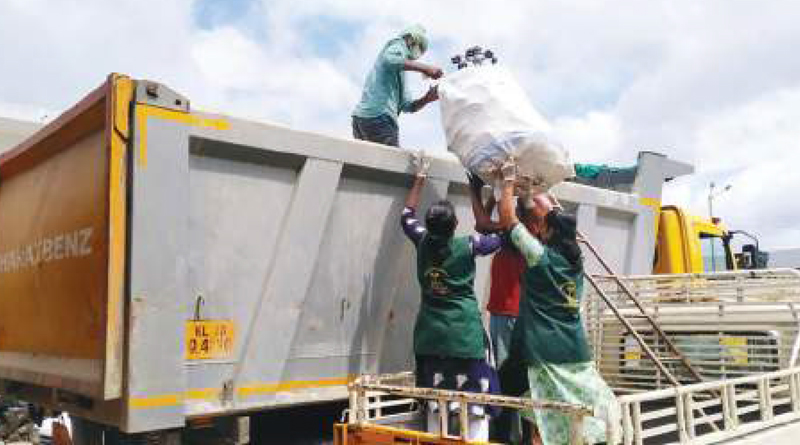
Just then, the sound of a pickup truck approaching the facility caught their attention. Two members who had been segregating materials rushed outside. The truck driver, a fellow Haritha Karma Sena member, announced that this was the second load of the day. She also mentioned that another three-wheeler pickup was on its way from the field. T hese vehicles, procured by the gram panchayat and handed over to the Haritha Karma Sena, played a crucial role in transporting collected waste materials efficiently.
T he consortium president, in charge of the facility, oversaw the unloading of the materials with the assistance of other members. Each sack was carefully weighed, and the details were recorded by the accountant in the inward register of the MCF. By tracking the collection points from various wards and cross-referencing reports from the Harithamithram application—used to monitor door to-door collection and service coverage—the consortium president strategized how to complete the month’s collection and segregation before the 28th. This was crucial as the contracted agency responsible for purchasing the segregated plastic and reject waste (non-recyclable waste used as fuel in cement kilns through controlled incineration) would arrive on that date for the first batch of the month.
She decided to discuss the action plan with other members in the upcoming weekly review meeting at the Haritha Karma Sena office. This office, newly constructed by the gram panchayat, was fully digitized with computers, internet access, and printers. She believed that, as a team, they could resolve any challenges—an understanding shaped by years of collective experience. This sentiment was shared by the entire team.
T he story of the Panayam Haritha Karma Sena is not unique. Across the state, similar teams operate with well equipped material collection facilities, transportation vehicles, and effective monitoring systems, ensuring efficient waste management services in every local self government(LSG).
The Pheonix that rose from ashes
T he Malinyamuktham Nava Keralam Campaign significantly expanded waste management facilities and activities in the state. Launched on March 15, 2023, in response to the Brahmapuram fire incident, this campaign was not entirely new but rather an extension of the waste management initiatives under the Haritha Keralam Mission, which had been active since 2017. However, the most significant transformations occurred post-2023. Over the past two years, the number of collection and processing facilities, Haritha Karma Sena members, and private sector participants in waste management has surged. Additionally, Kerala became the first state to implement state-wide full digitalization of door-to-door waste collection.
Beyond numbers, there has been a substantial improvement in the quality of waste management services delivered by each LSG through the Haritha Karma Sena. This model stands as Kerala’s unique contribution to the world—a demonstration of how waste management and climate resilience can be leveraged for women’s empowerment and local economic development. Originally established as a micro-enterprise under the Kudumbashree Mission, the Haritha Karma Sena has grown into the highest income generating single enterprise under the mission. Currently, it generates an average monthly income of ₹38 crore and continues to expand. Among the various Haritha Karma Sena consortiums in the state, several successful models have emerged. Ongoing studies are exploring the feasibility of replicating these models to other groups. With sustained efforts, the Haritha Karma Sena is poised to reach new heights in the future. Some of the key identified models apart from Panayam Panchayat are as follows:
Purathur Model of Economic and Social Security
T he Haritha Karma Sena model in Purathur Gram Panchayat, Malappuram district, is a highly successful and distinctive initiative in waste management. One of its major achievements is source-level waste segregation in 80% of households. Since segregation is done at the source itself, the time spent by Haritha Karma Sena members on segregation at the Material Collection Facility (MCF) has significantly reduced. Another notable innovation is the introduction of an Annual User Fee system. The three-tier organizational structure of the Haritha Karma Sena is another significant feature of the Purathur model. To ensure efficient and timely waste collection and high-quality service delivery, the consortium has implemented a decentralized system. This includes:
In total, 37363 Haritha Karma Sena workers are involved in the collection, transport and segregation of waste materials all over the state, handling almost 1.55 Lakh ton non-biodegradable waste per year. Thus, it becomes a highly successful model of circular economy and one of the biggest climate actions through waste management in the whole world. Another unique Kerala Model!
170 clusters, each consisting of 50-60 households.
• 17 ward-level organizing committees, formed by combining multiple clusters. • A panchayat-level organizing committee, consisting of representatives from all ward committees.
T his well-structured system ensures smooth communication of service updates and waste collection-related notifications, minimizing delays and improving efficiency.
Additionally, the consortium has introduced Employee State Insurance (ESI) and Provident Fund (PF) benefits for all members by setting aside a portion of the income.
Irattayar Model: Elevating Kerala’s Reputation
T he Haritha Karma Sena of Irattayar Grama Panchayat in Idukki district has gained national attention after being recognized in this year’s Economic Survey Report for its achievements in waste management. Through a well-structured approach, the Haritha Karma Sena has successfully provided waste management services to 5,030 households and 495 institutions within the local self government area, ensuring 100% coverage. Despite the challenges posed by the terrain, their relentless dedication and the strong support of the local self-government have made this success possible.
Every month, the Haritha Karma Sena collects segregates and processes between 4.5 to 10 tons of waste, handing it over to Clean Kerala Company and private agencies for recycling and disposal. A total of 28 different types of non biodegradable waste are currently being segregated, which increases their market value while significantly reducing the volume of reject waste.
In addition to non-biodegradable waste collection, the Haritha Karma Sena Consortium manages a community composting system as a separate enterprise.
Muttar Model: Overcoming Limitations with Innovation
Muttar Grama Panchayat in Alappuzha district stands as a remarkable example of how effective waste management can be achieved despite various limitations. Muttar is a small, rural panchayat with no major commercial or industrial establishments. With only 13 wards and 26 Haritha Karma Sena members, the panchayat operates in a flood-prone area, where waterlogging occurs during the monsoon season. Despite these challenges, Muttar has developed a unique and resilient waste management model. Over the past one and a half years, the Haritha Karma Sena and local governance system have successfully ensured 100% door to-door waste collection. Operating from a rented 520 sq. f t. building without any advanced machinery, the Material Collection Facility (MCF) processes an average of 2 tons of non-biodegradable waste per month. To generate additional income, the panchayat introduced innovative initiatives such as banana leaf cultivation, renting out newspapers for public events and weddings, and establishing tailoring units.