

Towards a Waste-Free Future Campaign
Muhammed Huwaiz M.
Joint Director, State WM Cell
Principal Directorate -LSGD
Kerala’s innovative decentralized waste management system empowers citizens and local bodies alike, fostering civic responsibility, promoting sustainability, and setting a new benchmark for environmental care in India.
Kerala has taken the lead in implementing a decentralized model for waste management, understanding its crucial role in environmental conservation. This innovative approach empowers individuals to take responsibility for their own waste, promoting a sense of civic duty through the principle, “my waste is my responsibility.” By adopting this model, the state aims to foster a culture of scientifically managed waste disposal, encouraging active participation from all sections of society. The Indian Supreme Court, through several landmark judgments, has declared that the right to a clean environment falls under the fundamental right to life as outlined in Article 21 of the Indian Constitution. This includes the right to clean air, soil, and water. The Court has further emphasized the correlation between these rights and the duties defined under Article 51(g), which obligates citizens to protect and improve the natural environment, including forests, rivers, and lakes. This balancing act between rights and duties has been affirmed by the Supreme Court, especially in the case of the Vellore Citizens Welfare Forum, where the Court underlined the significance of the precautionary and polluter pays principles in sustainable development..
T he fire that broke out at the Brahmapuram waste treatment plant in February 2023 prompted a reassessment of the safety standards and operational protocols for waste management facilities. Several challenges emerged, including a shortage of land for setting up waste management units and public opposition to their establishment. In response to this, the Kerala government launched a pioneering programme aimed at achieving a waste-free state, known as “Maalinya Muktham NavaKeralam” (Clean Kerala Mission). This campaign has been implemented in a coordinated effort across various levels of government, including State, District, and Local Self-Government Institutions (LSGIs). The involvement of several organizations such as the Local Self Government Department, KILA, Haritha Kerala Mission, Kudumbashree Mission, and Suchitwa Mission has accelerated progress in this initiative.
A WhatsApp number, 9446700800, has been established for the public to report instances of waste dumping in public spaces and water bodies.
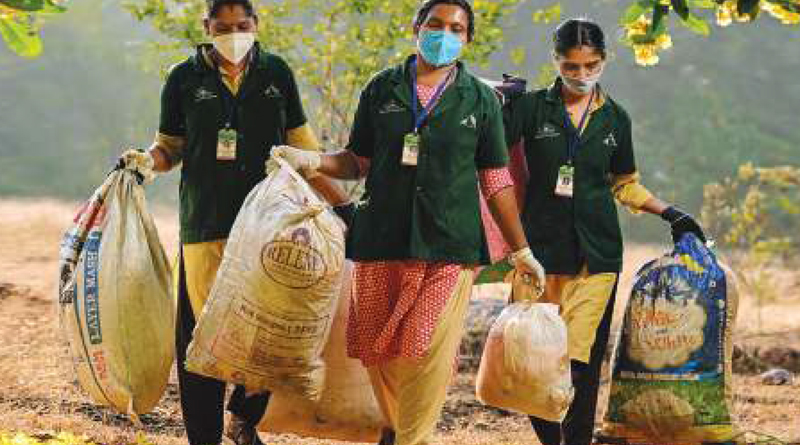
Initially, the Kochi Corporation struggled to find land for Material Collection Facility (MCF) centres. The issue was addressed by deploying Container MCFs in places like Ernakulam, Thiruvananthapuram, and Kozhikode, where space was unavailable. The primary goal was to strengthen the Haritha Karma Sena (HKS) in both urban and rural local bodies to improve waste collection. As a result, the number of HKS members increased from 33,378 in March 2023 to 37,363 by January 2025. This growth has helped raise the door-to-door waste collection rate from 47% to 97%, and user fee collection has also risen from 35% to 72%
One of the early initiatives in the campaign focused on clearing garbage vulnerable points (GVPs) and transforming them into butterfly gardens called “Sneharamams.” Students from schools and colleges, particularly those involved in the National Service Scheme (NSS), participated enthusiastically in this endeavour, resulting in the transformation of nearly 3,000 GVPs into these Sneharamams.
An essential part of the waste management system involves the segregation and storage of non-biodegradable waste. Local bodies have increased the number of Mini MCFs, MCFs, and Recycling and Refuse Facilities (RRFs). In locations where land is limited, the authorities have opted for Container MCFs or leased land for waste management purposes. A system has been set up to ensure the timely clearance of waste from these facilities. To facilitate efficient waste handling, a mandatory transportation and lifting plan has been introduced, linking the MCFs and RRFs to cement factories and recycling centres through the Clean Kerala Company Limited and other agencies authorised by the Suchitwa Mission.
To streamline waste management services and improve public access to information, the HarithaMithram app was introduced. Currently, 1,018 LSGIs use the app to deliver services to citizens, and 15 more LSGIs are set to integrate their systems with the app. Furthermore, a WhatsApp number, 9446700800, has been established for the public to report instances of waste dumping in public spaces and water bodies. This system is integrated with the War Room Portal and is being monitored by the State Control Room, ensuring effective response and resolution of complaints.
T he decentralised system for processing bio-waste, which had been in place, has been further strengthened. Inoculum for composting waste at the household and institutional level, through systems like biobins and ring composts, is being provided. Overflow waste is processed at the community level using aerobic units and Thumboormoozhi, with Bio Shakti& OWC plants also incorporated into the system. To manage poultry waste, 39 rendering plants with a combined capacity of 898.25 tonnes per day have been set up in collaboration with private entities. These plants convert poultry waste, including feathers, into animal and f ish feed through steam cooking.
Centralized waste processing is also being scaled up. For example, Kochi Corporation, in partnership with Bharat Petroleum Corporation Ltd (BPCL), is developing a Compressed Bio Gas (CBG) plant, expected to be operational by March 2025. Thiruvananthapuram and Kozhikode Corporations are also working with BPCL to establish similar plants. Additionally, construction of a Waste-to-Energy (WtE) plant has begun in Kanjikode, Palakkad, under the Kerala State Industrial Development Corporation (KSIDC).
As part of the state’s policy framework, green checkposts have been established at interstate borders, and a ban on single-use plastic has been enforced in tourism destinations and hilly areas. These measures aim to reduce plastic waste and protect the environment.
T he growing urban population in Kerala, coupled with the increasing availability of products from manufacturers and importers, has intensified the need for waste management systems capable of handling all types of waste. The inclusion of Producer-Importers, Brand Owners (PIBOs) under the Extended Producer Responsibility (EPR) framework will play a crucial role in addressing this issue.
A key challenge remains the indiscriminate dumping of mixed waste and a general lack of awareness about the environmental consequences of polluting public spaces and water bodies. To counter this, targeted public awareness campaigns are essential to educate citizens about the importance of proper waste disposal and the benefits of adopting eco-friendly practices. The implementation of Green Protocols at public events and functions can significantly contribute to reducing waste. Behavioural changes are necessary to make these initiatives effective, and it is crucial to assess the success of these campaigns through tangible changes in waste management practices across society.
Despite efforts to raise awareness, non-compliance continues to be a problem. As a result, the government has introduced stricter measures, including heavy fines and the possibility of prosecution for offenders. The Kerala Panchayati Raj Act and Kerala Municipality Act were amended in 2024 to ensure stringent penalties for those violating waste management rules. Vigilance squads have been set up in all LSGIs and districts to ensure proper enforcement.
Addressing these challenges requires effective waste management strategies, such as waste segregation at the source. Active public participation is essential for the success of these initiatives. To this end, extensive cleaning drives are being organized in partnership with local bodies, community groups, and organizations. These initiatives aim to create a cleaner and healthier environment while fostering a culture of sustainability and responsible waste management. Achieving a garbage-free Kerala requires a collective effort from all sections of society, involving a shift in habits and practices towards more sustainable waste management methods. By working together, Kerala can lead the way in waste management and environmental protection, paving the way for a cleaner, greener future.